Could Voice Search Send More Patients to Your Clinic? Reading the Spoken Questions, the Five Steps and the Sample Answer Coverage
A question-and-answer guide to healthcare voice search optimization in the United States: why spoken questions miss clinics, 5 organic steps, a weak vs stronger table, a sample answer-coverage chart, accuracy rules and FAQs.
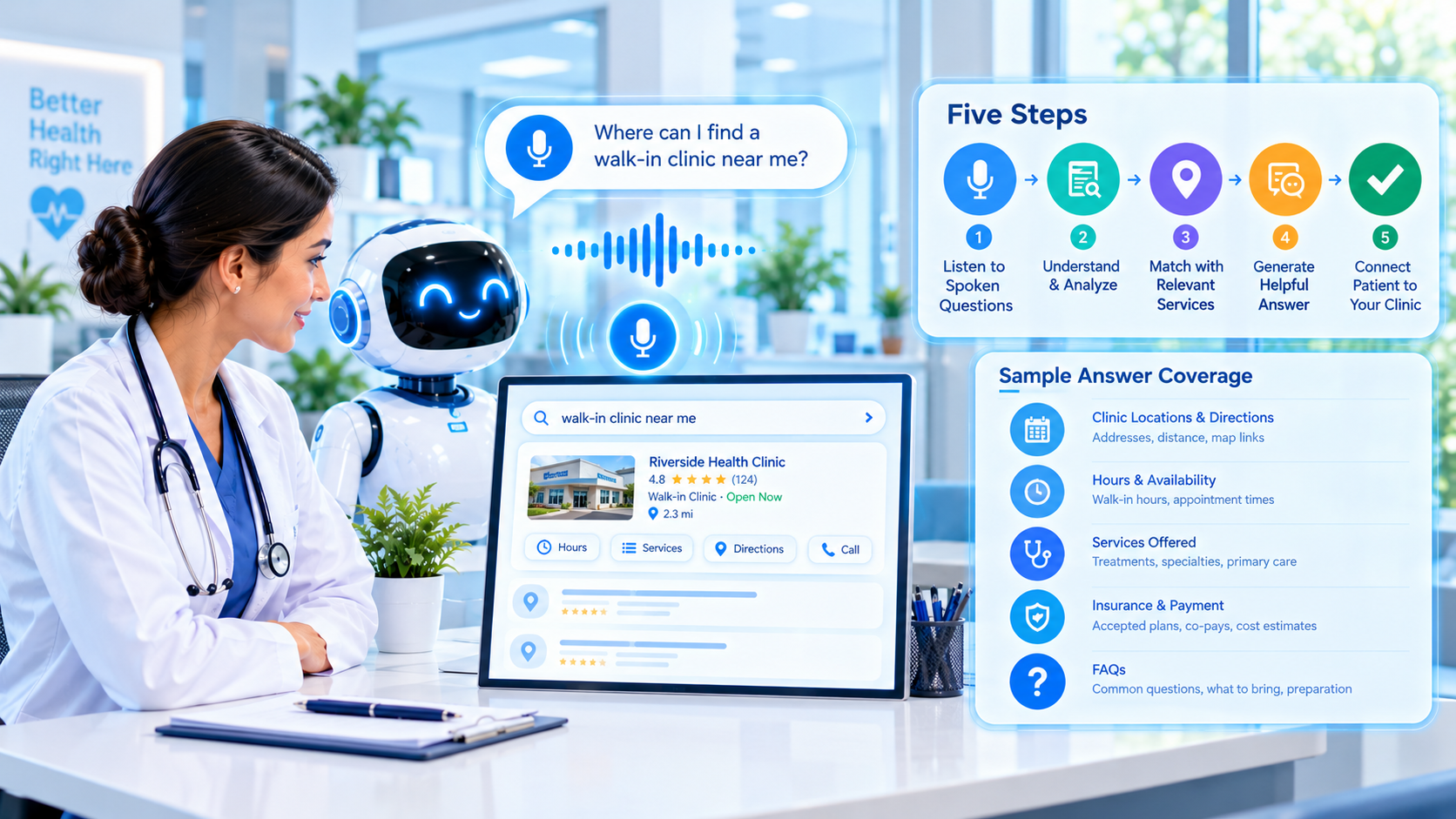
Healthcare voice search optimization is the organic work of making your clinic easy to find and easy to understand when people speak a question to their phone, smart speaker or car instead of typing it. In the United States, many people ask spoken questions such as "Where is the nearest urgent care that is open right now?" or "Does this clinic take my insurance?" Voice results are short, so the clinic that gives a clear, accurate, local answer is the one that gets heard. This guide explains, in a question-and-answer format, how a healthcare practice can prepare for spoken searches in five steps, with a sample result and a checklist for accuracy and privacy. It uses no paid advertising.
Key Findings
- 5 steps prepare a clinic for voice search: collecting spoken-style questions, writing short direct answers, keeping local details exact, making pages fast and clear on a phone, and a monthly review.
- In the illustrative model below, the number of target spoken questions with a short, direct answer on the site rises from 4 to 24 out of 30 when all five steps are in place.
- Short direct answers placed under question headings give the biggest lift in the sample, because spoken results favor one clear answer.
- 4 numbers are enough to track progress: question coverage, organic visits to answer pages, calls from the profile and direction requests.
- All figures in this article are illustrative examples, not guaranteed results. Voice assistants differ, and no one can guarantee a clinic will be read aloud.
What Is Healthcare Voice Search Optimization?
It is writing and organizing your information so a spoken question can be answered from it. Spoken questions are longer and more natural than typed ones. They are often local ("near me," "open now"), practical ("do you take Medicaid") or simple health questions ("how long does a sprain take to heal"). Voice assistants commonly draw on search results and business listings, so the same foundations that help in text search also help here. It builds on our guides to healthcare FAQ pages and AI Overviews for healthcare.
Why Do Many Healthcare Sites Miss Spoken Searches?
Most miss them because the answers are buried or the details are inconsistent. Common causes include:
- Answers sit inside long paragraphs or PDFs, with no short direct reply under a clear question.
- Hours, address or phone number differ between the website and the Google profile.
- Pages load slowly or are hard to read on a phone.
- Insurance accepted and new-patient status are not stated plainly.
- Pages use only formal medical terms and never the plain words people say aloud.
How Can Practices Prepare for Voice Search? 5 Steps
1. Collect Spoken-Style Questions
Start with how people really ask. Review your queries in Google Search Console, listen to phone calls and list the questions your front desk answers every day. Group them into local ("open now," "near me"), practical (insurance, wait times, parking) and simple health questions, using the approach in our guide to healthcare keyword research.
2. Write Short, Direct Answers
Put the answer first. Under each question heading, write a plain answer of about two sentences, then add detail below it. Keep medical answers general and reviewed by a clinician, and show who reviewed them using healthcare E-E-A-T signals. Use conditions, treatments and providers pages for the longer explanations.
3. Keep Local Details Exact
Spoken results depend on trusted local data. Make your hours, address, phone number, services and new-patient status identical on your site, your Google profile and your listings, as explained in our guides to Google Maps marketing and local citations. Write clear title tags and meta descriptions for each location. For multi-location groups, see local SEO for multi-location providers.
4. Make Pages Fast and Clear on a Phone
Most spoken searches happen on mobile. Keep pages light, use readable text and make the phone number and directions one tap away. Check accessibility, publish a plain insurance accepted page and design booking with healthcare landing page principles. Add key pages in other languages if your community needs them.
5. Review Results Every Month
A short monthly check keeps answers current. Ask a phone assistant your top questions, note what it says, and fix pages or listings that give wrong or missing answers. Update seasonal answers with a healthcare content calendar and handle reviews with care using healthcare reputation management principles.
| Area | Common weakness | Stronger approach |
|---|---|---|
| Answers | Buried in long text or PDFs | Short direct answer under each question heading |
| Local details | Different on site and profile | Identical hours, address, phone and services everywhere |
| Language | Formal terms only | Plain words people say aloud, with medical terms added |
| Mobile | Slow, small text | Fast pages with one-tap call and directions |
| Upkeep | Never tested | Monthly check of spoken answers |
How Much Coverage Can a Practice Build? A Sample Graph
In this illustrative example for a four-location primary care group, spoken questions with a short direct answer on the site rise from 4 to 24 out of 30. The bars run from top to bottom in the same order as the table below, and each block (█) equals 1 question.
| Stage | Target questions with a direct answer (out of 30) | Bar chart |
|---|---|---|
| Typical site, answers buried | 4 | ████ |
| Plus short direct answers under questions | 13 | █████████████ |
| Plus exact local details everywhere | 19 | ███████████████████ |
| Plus fast mobile pages and monthly review | 24 | ████████████████████████ |
What Should Practices Measure?
Four measures show whether the work is helping.
- Number of target questions with a short, direct answer on the site.
- Organic visits to question and answer pages.
- Calls and direction requests from your Google profile.
- Accuracy checks: how many spoken answers from a phone assistant match your real details, tracked together with patient retention and appointment results.
What Accuracy and Privacy Rules Apply?
A spoken answer has no room for caveats, so accuracy matters more.
- Keep medical answers general and reviewed by a clinician, and do not give personal diagnosis or dosing advice.
- Include emergency guidance. Make clear that anyone with a medical emergency should call 911.
- Do not publish guaranteed wait times, prices or coverage claims you cannot keep current.
- Do not put patient information into answer pages, forms or tools that are not covered by your privacy agreements.
- Do not promise that any assistant will read your clinic's answer aloud. Voice products change often.
Methodology and Limitations
The numbers in this article come from an illustrative model created by Nova Reach Digital to show how each step may affect answer coverage. They are not drawn from a published study or a specific practice, and no one can guarantee voice results. Different assistants use different sources and change them over time. This article is general information and not medical or legal advice.
Related Reading
- Healthcare SEO audit
- Healthcare video SEO
- Healthcare content marketing
- Healthcare link building
- Snippet mistakes dental clinics make
Conclusion
Voice search rewards clinics that answer plainly and keep their details exact. Collect the questions people ask aloud, write short direct answers, match your site and listings and test the results every month. If you want help preparing a practice for spoken searches, contact Nova Reach Digital or read more about our healthcare marketing services.
Get Directions
Frequently Asked Questions
Keep reading
What Are the Top Email Marketing Automation Tools for Small Businesses? Reading the Tool Comparison, the Five Steps and the Sample Email Bookings
A question-and-answer guide to choosing among the top email marketing automation tools for small businesses: what they do, why programs underperform, 5 steps, a weak vs stronger table, a sample bookings chart, rules and FAQs.
What Are the Top Social Media Automation Tools for Small Businesses? Reading the Tool Comparison, the Five Steps and the Sample Posting Time
A question-and-answer guide to choosing among the top social media automation tools for small businesses: what to automate, why accounts feel robotic, 5 steps, a weak vs stronger table, a sample time-savings chart, rules and FAQs.
How Do You Choose Among the Top Digital Marketing Agencies in NYC? Reading the Agency Types, the Five Steps and the Sample Cost Per Customer
A question-and-answer guide to choosing among the top digital marketing agencies in NYC: what agencies do, why businesses switch, 5 steps to choose, an agency-types table, a sample cost-per-customer chart, rules and FAQs.
Put These Ideas to Work with NovaReach
Automate your marketing, launch AI voice agents, and keep every lead moving, all from one dashboard.