Does Your New York Business Need AI Marketing Automation? What the Signs Reveal, the Readiness Test They Trigger, and What Each Signal Counts
Discover the real signs that show whether your New York business is ready for AI marketing automation, from repetitive manual tasks and missed leads to growing customer follow-up demands and changing adoption trends. Explore practical readiness indicators backed by current U.S. small business AI adoption research.

What Are the Real Signs Your New York Business Is Ready for AI Marketing Automation?
Seven Data Backed Indicators, Based on Current US Small Business Adoption Research
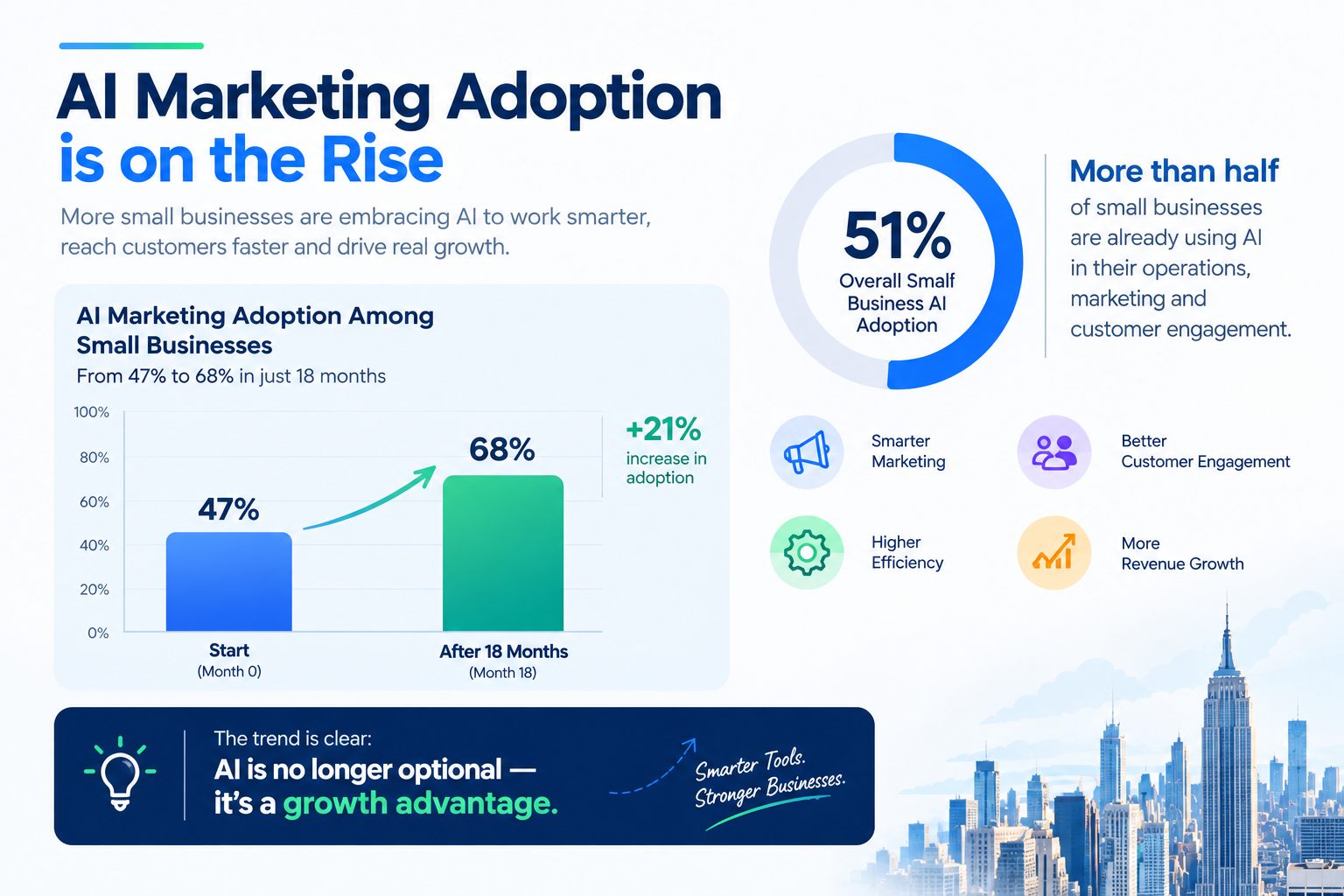
Why do some New York businesses jump into AI marketing automation while others sit on the sidelines even though the tools are readily available? Recent research from the US Chamber of Commerce found AI adoption among companies with under 500 employees has reached 51 percent, with marketing automation specifically used by 43 percent, a 13 point jump from the year before. Nova Reach Digital put this guide together using current adoption data, so New York business owners can recognize the real signs they are ready to move, rather than guessing.

At a Glance
-
AI adoption among US small businesses with under 500 employees has reached 51 percent, with 43 percent specifically using marketing automation tools.
-
68 percent of small businesses report using AI regularly, a 42 percent jump year over year, according to recent small business survey data.
-
Small business owners using AI are nearly twice as likely to report year over year growth compared to non adopters.
-
Among businesses with 10 to 100 employees, AI adoption jumped from 47 percent to 68 percent within about a year and a half.
-
82 percent of the smallest businesses, those under 5 employees, cite a belief that AI is not applicable to their specific business as the main reason for not adopting it yet.
What These Signs Actually Look Like in Practice
If your team is spending hours every week manually pulling reports, updating spreadsheets, or scheduling social posts one at a time, that is one of the clearest signs automation would genuinely help. This is not a sign you are behind, it is simply the point where the return on automating these specific tasks becomes obvious rather than theoretical. Recognizing this moment, rather than waiting until the workload becomes unmanageable, tends to lead to a smoother transition.
Another real sign is when your business has grown enough that manually tracking leads or customer follow ups starts causing genuine gaps, a lead forgotten, a follow up delayed, a customer who fell through the cracks. Research shows businesses that adopt AI at this stage are nearly twice as likely to report year over year growth compared to those that wait, suggesting timing genuinely matters here. If this sounds familiar, it is a strong practical signal that your business has reached the point where automation adds real value rather than unnecessary complexity.
A third sign worth taking seriously is simply feeling behind competitors who seem to respond faster, personalize more, or show up more consistently online. Given that adoption among businesses similar in size to yours has climbed sharply in a relatively short window, this feeling is often not imagined, it reflects a genuine shift already underway among comparable businesses. Trusting that instinct, rather than dismissing it, is a reasonable way to recognize your own readiness.
Image alt text: "Business owner reviewing manual marketing tasks that could be automated for a New York business"
-
Notice if your team spends real hours weekly on manual reporting or scheduling
-
Recognize growth related gaps, like missed leads or delayed follow ups, as a genuine signal
-
Trust the feeling of falling behind faster moving competitors, this is often accurate
-
Understand that adoption timing itself is associated with stronger growth outcomes
Why the Adoption Gap Is Closing So Quickly
The data on this shift is genuinely striking. Large enterprises used AI at close to double the rate of small firms in early 2024, but by mid 2025 that gap had narrowed considerably as small business adoption accelerated while large firm growth leveled off. This matters for New York businesses specifically, since it suggests the competitive advantage of adopting early is shrinking, and the real risk increasingly sits with businesses that wait too long rather than those that move now.
Why the Biggest Barrier Isn't Cost, It's Awareness
This is worth understanding clearly, since it changes how you should think about your own hesitation. Research consistently finds that among the smallest businesses specifically, the dominant reason for not adopting AI marketing tools is a belief that it simply does not apply to their type of business, not cost or lack of access. This points to an awareness gap rather than a genuine incompatibility, meaning if you have been holding back for this reason, it is worth revisiting that assumption directly rather than treating it as settled.
Conclusion
Recognizing readiness for AI marketing automation comes down to a few genuine, observable signs: real hours lost to manual work, growth related gaps starting to show, and a nagging sense that competitors are simply moving faster. Current adoption data backs up the instinct that timing matters, with early adopters reporting meaningfully stronger growth outcomes than those who wait. Nova Reach Digital helps New York businesses recognize these signs clearly and act on them with a system built for their specific stage of growth.
Frequently Asked Questions
Keep reading
Does AI Marketing Really Help Small New York Businesses Compete With Larger Brands? What the Research Reveals, the Competitive Test It Turns On, and What Each Advantage Counts
Can AI marketing actually help small New York businesses compete with larger brands? This guide examines what recent research reveals about AI-driven gains in speed, consistency, content volume, time savings, and the specific competitive gaps AI can help narrow.
Does Manual Marketing Still Work for New York Businesses? What the Process Reveals, the Automation Test It Turns On, and What Each Workflow Counts
What does manual marketing actually cost New York businesses? This guide examines the time lost to repetitive reporting, data collection, and other workflows, what automation reveals about those inefficiencies, and where targeted AI marketing automation can help teams recover valuable time for strategy and growth.
Does AI Really Improve the Customer Journey for Local New York Businesses? What Personalization Designates, the Test It Turns On, and What Each Interaction Counts
How does AI change the customer journey for local New York businesses? This guide examines what personalization reveals about customer expectations, where generic marketing falls short, and how AI can help businesses deliver more relevant messages, stronger engagement, and better customer experiences.
Put These Ideas to Work with NovaReach
Automate your marketing, launch AI voice agents, and keep every lead moving, all from one dashboard.