AI Content Marketing for Small Businesses: A Step-by-Step Workflow for Automated Content Creation That Still Sounds Human
Learn how small businesses use AI content marketing and automated content creation to publish helpful content consistently, with a step-by-step workflow, prompt tips and quality controls.
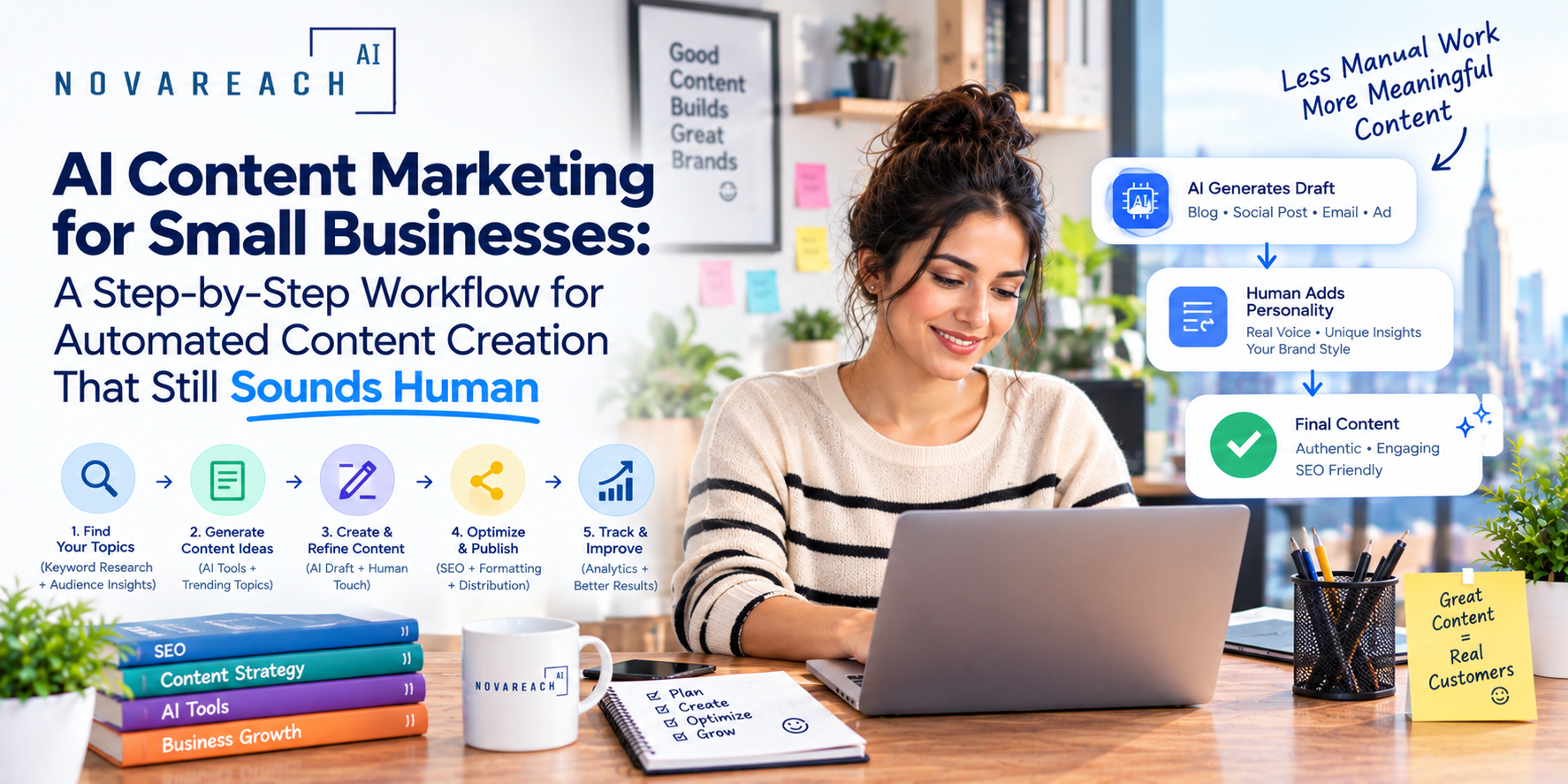
Content is still one of the most reliable ways for a small business to earn trust and attract customers. The challenge is volume and consistency. Blog posts, emails, social captions, product descriptions and landing pages all need to be written, edited and published, and most owners have no spare hours. AI content marketing offers a practical answer: use AI to speed up the heavy lifting, and keep people in charge of strategy, accuracy and voice.
This guide walks through how small businesses can use AI content creation and automated content creation workflows to publish more helpful content without sacrificing quality, plus the guardrails that keep your brand credible.
What AI Content Marketing Really Is
AI content marketing is the use of AI tools across the content process: researching topics, outlining, drafting, editing, repurposing and measuring results. It is not a way to flood the internet with generic text. The businesses that benefit most treat AI as a fast assistant and apply their own expertise to every piece before it goes live.
Where AI Saves the Most Time
- Topic research: Surfacing customer questions, related keywords and content gaps.
- Outlines: Producing a logical structure with headings that match what searchers want to know.
- First drafts: Creating a starting point so you are editing instead of facing a blank page.
- Repurposing: Turning one article into email newsletters, social posts, short videos scripts and FAQs.
- Editing support: Tightening language, checking tone and catching repetition.
- Metadata: Suggesting titles, meta descriptions and internal link ideas.
Where Humans Must Stay in Charge
Some parts of content marketing should never be fully automated:
- Strategy: Deciding who you are talking to and what you want them to do next.
- Accuracy: Verifying facts, figures, legal claims and anything customers might rely on.
- Experience and stories: Real examples, results and lessons that only your business has.
- Brand voice: The personality that makes your content recognizable.
- Final approval: A person should read everything before it is published.
Building an Automated Content Workflow
A repeatable process matters more than any single tool. Here is a workflow small businesses can adopt:
- Plan monthly. Choose three to five topics tied to your services and your customers' top questions. Assign each a main keyword and a purpose, such as educating, comparing or converting.
- Brief the AI properly. Give it the audience, goal, key points, tone, location and any facts it must include. Better briefs produce better drafts.
- Generate an outline first. Review the structure before writing begins, and reorder or remove sections that do not serve the reader.
- Draft section by section. Shorter prompts for each section usually produce more focused text than one giant request.
- Add the human layer. Insert real examples, local details, customer stories, data you can stand behind and your own opinions.
- Edit for clarity and accuracy. Remove filler, fix errors and make sure each paragraph earns its place.
- Optimize and publish. Add a clear title, meta description, headings, internal links and a call to action.
- Repurpose. Turn the article into several smaller pieces for email and social channels.
- Measure and refresh. Track traffic, engagement and leads, then update pages that are close to performing.
Writing AI Prompts That Produce Better Content
The quality of AI output depends heavily on the instructions you provide. A strong prompt usually includes:
- Audience: Who is reading and what they already know.
- Goal: What the content should help them decide or do.
- Tone: Friendly, expert, plain-spoken or formal.
- Structure: Headings, length and format.
- Constraints: Words or claims to avoid, facts to include and sources to rely on.
Save prompts that work well and reuse them. Over time you will build a small library that speeds up every new piece.
Content Types That Work Well for Small Businesses
- How-to guides: Walk customers through a problem you solve every day.
- Comparison pages: Help buyers weigh options honestly.
- Local content: Articles tied to your service area, neighborhoods and seasonal needs.
- FAQs: Short, direct answers to the questions your team hears constantly.
- Case studies: Before-and-after stories that prove results.
- Email newsletters: Regular, useful updates that keep you top of mind.
Quality Controls to Protect Your Brand
- Fact-check everything. AI can state wrong information confidently.
- Avoid duplicate-sounding content. If a page could be swapped onto a competitor's site, it needs more of your own perspective.
- Disclose where appropriate. Follow platform and industry rules about AI-generated material and endorsements.
- Respect copyright. Do not copy other publishers' text or images.
- Keep a style guide. A short document with your voice, preferred terms and formatting keeps everything consistent.
How AI Content Supports SEO
Helpful, original content that matches search intent can earn visibility over time. AI helps you cover more of the topics your customers search for and keep existing pages fresh. But ranking still depends on usefulness, clear structure, a solid website and credibility signals such as reviews and links. Treat AI as a way to be more consistent, not as a shortcut around quality.
Measuring Results
Pick a handful of metrics and review them monthly: organic traffic, time on page, leads from content, email sign-ups and the pages that assist conversions. Compare AI-assisted pieces with fully manual ones to see where your editing effort pays off. Use what you learn to refine briefs, topics and formats.
Mistakes to Avoid
- Publishing without a human edit.
- Writing for keywords instead of people.
- Ignoring your own expertise. Your real experience is what makes content stand out.
- Posting inconsistently. A steady schedule beats occasional bursts.
- Never updating old content. Outdated advice hurts trust.
Final Thoughts
AI content marketing lets small businesses publish consistently and compete with larger brands, as long as people remain responsible for accuracy, insight and voice. Build a simple workflow, write strong briefs, add your real experience and measure what works. If you would like support creating an AI-assisted content engine for your business, Nova Reach Digital can help you plan, produce and publish it.
Frequently Asked Questions
Keep reading
AI Marketing Strategy for Small and Local Businesses: How to Choose AI Marketing Tools and Map the Customer Journey
Learn how to build an AI marketing strategy for your small or local business: set goals, map the customer journey, choose AI marketing tools wisely and follow a practical 90-day roadmap.
AI Marketing Workflow and Business Process Automation: How Small Businesses Save Hours Every Week and Boost Productivity
Learn how AI marketing workflows and business process automation improve marketing efficiency and productivity for small businesses, with a task audit, five workflows to build first and a four-week rollout plan.
Local SEO for Local Businesses: The Complete Guide to Improving Local Search Visibility, Google Maps Rankings and Local Ranking
A practical local SEO guide for US businesses: how local rankings work, the factors that matter most and a 90-day plan to improve local search visibility and Google Maps results.
Put These Ideas to Work with NovaReach
Automate your marketing, launch AI voice agents, and keep every lead moving, all from one dashboard.