AI Marketing Strategy for Small and Local Businesses: How to Choose AI Marketing Tools and Map the Customer Journey
Learn how to build an AI marketing strategy for your small or local business: set goals, map the customer journey, choose AI marketing tools wisely and follow a practical 90-day roadmap.
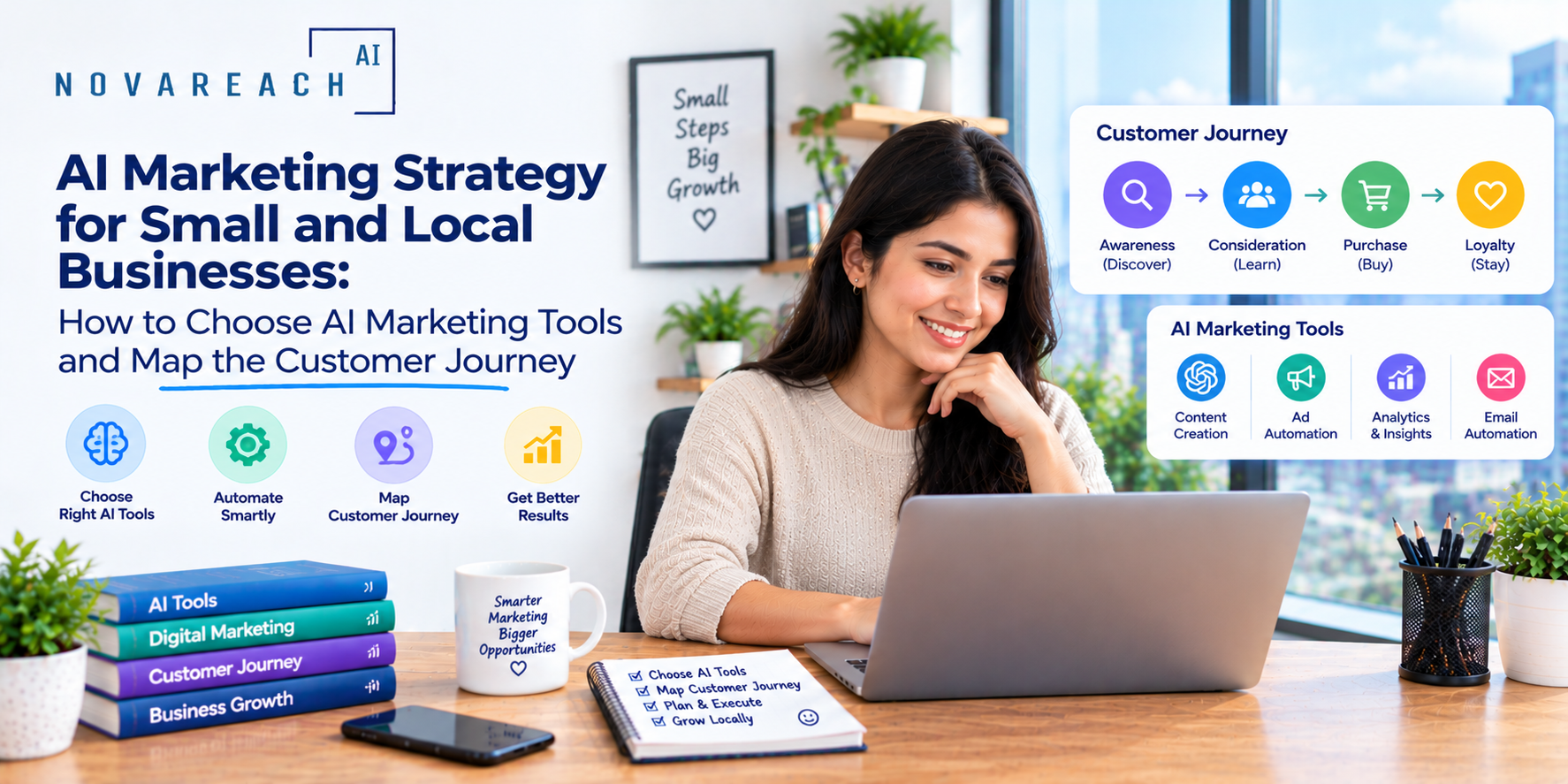
Most small businesses do not have a marketing problem. They have a focus problem. There are hundreds of AI marketing tools, dozens of channels and endless advice, and it is easy to end up with a pile of subscriptions and no clear plan. An AI marketing strategy fixes that by starting with business goals and choosing tools and tactics that serve them.
This guide explains how to build an AI marketing strategy for a local or small business, how to choose AI marketing tools wisely, how to map the customer journey and how to avoid the mistakes that waste money and time.
What Is an AI Marketing Strategy?
An AI marketing strategy is a plan that defines who you want to reach, what you want them to do and how AI and automation will help you get there more efficiently. It is not a list of tools. It is a set of decisions about priorities, messages, channels, workflows and measurement. Tools are chosen afterward to support those decisions.
Step 1: Set Clear Business Goals
Strategy begins with outcomes. Examples of clear goals include increasing booked appointments by twenty percent in six months, reducing missed calls, growing monthly leads from local search or lowering cost per customer. Avoid vague goals like "do more marketing." Choose one or two primary goals so your effort stays focused.
Step 2: Understand Your Customers
List your best customer types and answer a few questions for each: What problem are they trying to solve? Where do they look for help? What makes them hesitate? What convinces them to choose you? Use customer conversations, reviews, sales call notes and search data. AI can help summarize patterns from this information, but the insights should be checked against what you know about your market.
Step 3: Map the AI Customer Journey
The customer journey describes the steps from first awareness to repeat purchase. Mapping it shows where AI and automation can help:
- Awareness: People discover you through search, maps, social media, referrals and ads. AI supports content creation, SEO research and ad testing.
- Consideration: They compare options and read reviews. AI helps with review management, FAQ content and chat assistants that answer questions.
- Decision: They contact you. AI voice agents, instant replies, lead qualification and online booking reduce friction.
- Service delivery: They become customers. Automated confirmations, reminders and onboarding messages keep things smooth.
- Retention and advocacy: They return and refer others. Follow-up emails, review requests and re-engagement campaigns help.
Look for stages where leads are lost or delayed. Those are your best opportunities.
Step 4: Choose Your Priority Channels
You cannot be everywhere. Choose two or three channels that match where your customers are:
- Local SEO and Google Business Profile for people searching nearby.
- Website and content for education and trust.
- Email and text for nurturing and retention.
- Social media for community, visibility and proof.
- Paid ads for faster, testable demand.
- Phone and messaging for fast response and booking.
Step 5: Choose AI Marketing Tools Wisely
Tools should fit your strategy, not the other way around. Group them by job:
- CRM and contact management: The central place for leads and customers.
- Email and SMS automation: Follow-up, reminders and campaigns.
- AI voice and chat assistants: Call answering, qualification and booking.
- Content and SEO tools: Research, outlines, drafts and optimization.
- Social media tools: Planning, scheduling and reporting.
- Analytics and reporting: Dashboards that tie marketing to revenue.
- Review and reputation tools: Review requests, alerts and response drafts.
When evaluating any tool, ask: Does it solve a specific problem in our journey? Does it integrate with our CRM and calendar? Can we export our data? Is pricing predictable? Will someone on our team actually use it? Begin with a short trial and a clear success measure.
Step 6: Design Your Core Workflows
Build the workflows that support your journey, starting with the biggest leaks. Common starting points are instant lead response, missed-call text-back, appointment reminders, review requests and a follow-up sequence for unconverted leads. Document each one: trigger, actions, hand-offs and goal.
Step 7: Create a Content and SEO Plan
Pick a handful of topics tied to your services and customer questions, then publish consistently. Use AI to speed up research and drafting, and rely on your team for expertise, examples and fact-checking. Strengthen local visibility with a complete Google Business Profile, strong reviews and location-specific pages where relevant.
Step 8: Set Metrics and Review Rhythm
Decide which numbers you will watch and when:
- Weekly: New leads, response time, calls, bookings.
- Monthly: Cost per lead, conversion rate, review count, traffic, revenue by source.
- Quarterly: Customer lifetime value, retention, channel mix and strategy adjustments.
Write down what you expect to see, then compare. Learning from the gap is where strategy improves.
Step 9: Add Guardrails
- Human review: Check AI-generated content and messages before they reach customers.
- Privacy and consent: Follow email, text, call recording and data protection rules.
- Honesty: Avoid exaggerated claims and fake reviews or testimonials.
- Brand voice: Maintain a simple style guide so everything sounds like you.
- Escalation paths: Make it easy for customers to reach a person.
A Sample 90-Day Roadmap
- Days 1 to 30: Define goals and customers, audit your current marketing, set up your CRM, fix your Google Business Profile and build the instant-response workflow.
- Days 31 to 60: Add reminders, review requests and a follow-up sequence. Publish your first set of helpful content and set up a weekly reporting snapshot.
- Days 61 to 90: Add an AI phone or chat assistant if appropriate, test one paid or social channel, review results and plan the next quarter.
Common Strategy Mistakes
- Buying tools first. Software without a plan creates clutter.
- Trying every channel. Focus beats breadth for small teams.
- Ignoring the basics. A clear offer, good reviews and fast response matter more than any tool.
- No measurement. Without numbers, you cannot improve.
- Over-automation. Customers still value human attention at key moments.
- Not updating the plan. Review your strategy each quarter and adapt.
Final Thoughts
A good AI marketing strategy is simple: know your goals and customers, map the journey, pick a few channels, choose tools that serve those choices and measure results. Use AI to move faster and stay consistent, and keep people in charge of relationships and judgment. If you would like help building an AI marketing strategy and choosing the right tools for your business, Nova Reach Digital can guide you from plan to launch.
Frequently Asked Questions
Keep reading
AI Marketing Workflow and Business Process Automation: How Small Businesses Save Hours Every Week and Boost Productivity
Learn how AI marketing workflows and business process automation improve marketing efficiency and productivity for small businesses, with a task audit, five workflows to build first and a four-week rollout plan.
Local SEO for Local Businesses: The Complete Guide to Improving Local Search Visibility, Google Maps Rankings and Local Ranking
A practical local SEO guide for US businesses: how local rankings work, the factors that matter most and a 90-day plan to improve local search visibility and Google Maps results.
AI Voice Agent for Small Businesses: The Complete Guide to Automated Phone Answering, Appointment Booking and Missed-Call Recovery
Learn how an AI voice agent handles automated phone answering, books appointments and qualifies leads for small businesses, plus setup steps, legal considerations and mistakes to avoid.
Put These Ideas to Work with NovaReach
Automate your marketing, launch AI voice agents, and keep every lead moving, all from one dashboard.