AI Receptionist for Hospitals and Clinics: How AI Call Answering Reduces Missed Calls and Improves Patient Access
Learn how an AI receptionist and AI call answering can help hospitals and clinics reduce missed calls, schedule appointments and route urgent matters, with clear boundaries and compliance guidance.
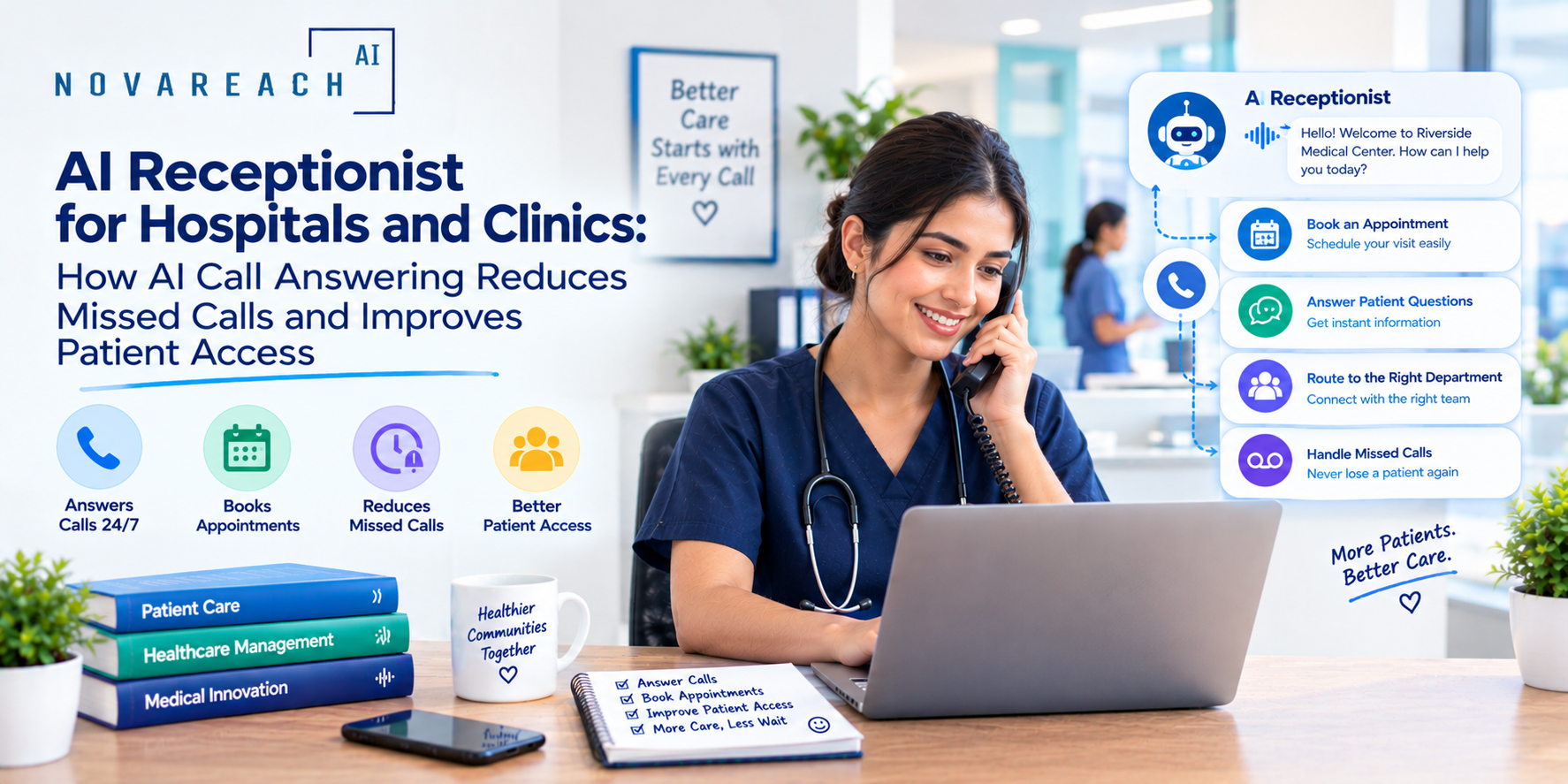
The phone is still the front door of most clinics and hospitals. Patients call to book appointments, ask about insurance, request refills, check directions or find out which department to contact. Yet front-desk teams are often stretched thin, juggling check-ins, insurance questions and ringing phones at the same time. The result is long hold times, abandoned calls and frustrated patients. An AI receptionist for healthcare offers a way to answer every call promptly, handle routine requests and route urgent matters to the right person, without replacing the human team that patients rely on.
This guide explains how AI call answering and AI voice agents can support hospitals, clinics and private practices in the USA, what they should and should not do, and how to implement them safely.
Why Missed Calls Matter in Healthcare
A missed call in healthcare is more than a lost sale. It can be a patient who delays care, a new patient who chooses another provider, an existing patient who becomes frustrated or an urgent concern that does not reach the right person. Calls tend to peak at opening time, during lunch and after hours. Phone lines that are busy or unattended at those times leave patients without help exactly when they need it.
What an AI Receptionist Can Do for a Clinic or Hospital
- Answer calls immediately, including during peak periods and after hours.
- Provide general information such as office hours, locations, parking, visitor policies, accepted insurance types and how to prepare for common visits, based on content approved by your staff.
- Schedule, reschedule or cancel appointments for eligible visit types connected to your calendar system.
- Collect basic details for new patient inquiries, such as name, callback number and preferred appointment time.
- Route calls to the correct department, such as billing, medical records, scheduling or a specific clinic.
- Send text confirmations and reminders with patient consent.
- Take messages and summarize them for staff in a structured format.
- Offer multilingual support in languages commonly spoken in your community.
What an AI Receptionist Should Not Do
Clear boundaries protect patients and your organization:
- It should not give medical advice, diagnose conditions or interpret symptoms or test results.
- It should not handle emergencies on its own. If a caller describes an emergency, the assistant should immediately tell them to hang up and call 911 or go to the nearest emergency department, and transfer to staff where appropriate.
- It should not make clinical decisions such as medication changes or triage outcomes unless a licensed clinical protocol and oversight are explicitly in place.
- It should not disclose protected health information without proper identity verification and policies approved by your compliance team.
Designing the Caller Experience
A good patient phone experience feels calm, clear and respectful:
- Greet warmly using your organization name and say that the caller is speaking with an automated assistant.
- Ask how it can help in an open way, then confirm what it heard.
- Offer a quick path to a person at any time, especially for urgent, sensitive or complex needs.
- Keep language simple and avoid jargon.
- Confirm details by repeating dates, times and phone numbers.
- Close with next steps and send a text confirmation when appropriate.
Accessibility matters too. Make sure patients who are hard of hearing, have speech differences or prefer another language have alternative ways to reach you.
Privacy and Compliance Considerations
- HIPAA and business associate agreements: If the AI system will create, receive, store or transmit protected health information, work with your compliance and legal teams to confirm that the vendor can meet the requirements and will sign the appropriate agreements.
- Identity verification: Define what the assistant may share and what requires verification or a human.
- Call recording and consent: State laws vary. Include required disclosures at the start of calls.
- Data retention: Decide how long recordings and transcripts are kept and who can access them.
- Security: Use access controls, encryption and audit logs, and review them regularly.
This article is general information, not legal advice. Consult qualified professionals for your organization's requirements.
Implementation Roadmap
- Analyze call data. Identify why patients call, when volume peaks and how many calls are missed or abandoned.
- Select call types for automation. Start with low-risk categories like hours, directions, appointment scheduling and general questions.
- Write approved content. Create accurate scripts and knowledge bases reviewed by clinical and administrative leaders.
- Define escalation rules. Specify keywords and situations that trigger immediate transfer to staff or emergency guidance.
- Integrate with scheduling systems where possible, and test thoroughly.
- Pilot in one department or after hours. Gather feedback from patients and staff.
- Monitor and improve. Review call transcripts weekly at first, then monthly.
- Expand gradually as performance and trust grow.
Metrics to Track
- Call answer rate and average time to answer.
- Abandoned call rate.
- Appointments scheduled through the assistant.
- Percentage of calls transferred to staff, and reasons.
- Patient satisfaction with phone experience.
- Staff time saved on routine calls.
- Safety review results, including any escalation failures.
Common Mistakes
- Launching without staff buy-in. Involve front-desk teams from the start. They know what patients ask.
- Weak escalation design. Test emergency and sensitive scenarios repeatedly.
- Outdated information. Update hours, policies and providers regularly.
- Treating AI as set-and-forget. Ongoing review is essential in healthcare.
- Ignoring patient preferences. Some patients will always prefer to speak to a person. Make that easy.
Final Thoughts
An AI receptionist can help hospitals and clinics answer more calls, shorten waits and free staff to focus on patients in front of them. Success depends on clear boundaries, strong privacy practices, thoughtful design and continuous monitoring. If you would like help planning an AI call answering and appointment booking solution for your healthcare organization, Nova Reach Digital can help you design and implement it responsibly.
Frequently Asked Questions
Keep reading
What Are the Top Missed-Call Text Back Setups for Clinics? Reading the Setup Table, the Five Steps and the Sample Missed-Call Follow-Up
A question-and-answer guide to the top missed-call text back setups for clinics: what it is, why missed calls cost patients, 5 setup steps, a setups table, a sample follow-up chart, texting and privacy rules and FAQs.
What Are the Top AI Chatbots for Healthcare Practices and How Do You Choose? Reading the Build Options, the Five Steps and the Sample Patient Inquiries
A question-and-answer guide to the top AI chatbots for healthcare practices: what they do, why they disappoint, 5 launch steps, a build-options table, a sample patient-inquiry chart, HIPAA and safety rules and FAQs.
What Are the Top AI Answering Services for Doctors and How Do You Choose? Reading the Service Types, the Five Steps and the Sample After-Hours Follow-Up
A question-and-answer guide to the top AI answering services for doctors: what they do, why after-hours calls get lost, 5 steps to choose, a service-types table, a sample follow-up chart, rules and FAQs.
Put These Ideas to Work with NovaReach
Automate your marketing, launch AI voice agents, and keep every lead moving, all from one dashboard.