Conversational AI for Healthcare: A Complete Guide for Hospitals and Healthcare Brands
A complete guide to conversational AI for healthcare: how hospitals use AI chatbots and voice assistants for patient communication, with safety boundaries, compliance essentials and a step-by-step rollout plan.
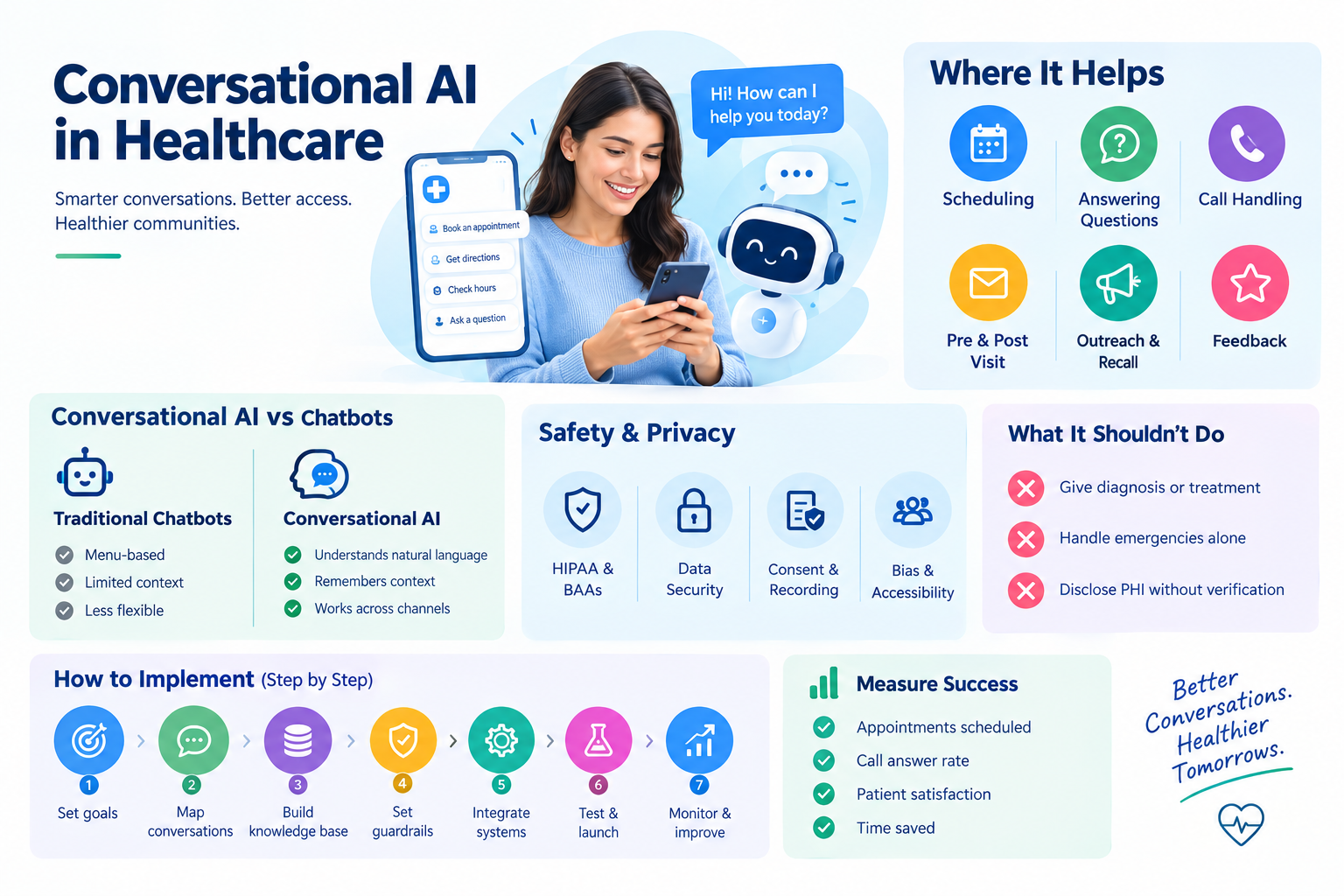
Healthcare runs on communication. Patients call, text, email, message through portals and ask questions across many channels, often when they are worried, busy or unsure what to do next. Conversational AI gives hospitals and healthcare brands a way to handle more of those conversations in a natural, helpful way, by voice or text, at any hour. It goes beyond the simple menu-driven bots of the past: modern conversational AI can understand everyday language, remember context within a conversation and guide people to the right next step.
This guide explains what conversational AI for healthcare is, where it fits across patient communication, how it differs from basic chatbots, what safeguards matter and how hospitals in the USA can adopt it responsibly.
What Is Conversational AI in Healthcare?
Conversational AI refers to technologies that let people interact with software using natural language, in speech or text. In healthcare, it powers AI chatbots, voice agents, virtual assistants and messaging tools that can answer questions, collect information, schedule appointments, send reminders and route requests. The goal for most hospital marketing and patient access teams is to improve access and communication, not to replace clinical judgment.
Conversational AI vs Traditional Chatbots
- Language understanding: Traditional bots rely on fixed menus or keywords. Conversational AI interprets natural phrasing, including misspellings and varied wording.
- Context: Conversational AI can follow the thread of a conversation, such as remembering the location a patient mentioned earlier.
- Channels: It can work across web chat, text messaging, phone calls and apps with a consistent experience.
- Flexibility and risk: This flexibility is useful, but it also requires stronger guardrails to ensure answers stay accurate and within approved boundaries.
Where Conversational AI Helps in Patient Communication
Patient Access and Scheduling
Patients can ask to book, change or cancel appointments in their own words. The system can offer available times, confirm details and send reminders. For complex scheduling rules, it can collect information and hand off to staff.
Answering Common Questions
Hours, directions, parking, visitor policies, accepted insurance types, what to bring to a visit and how to access records are common questions that conversational AI can answer consistently, using approved content.
Voice and Call Handling
Voice-based conversational AI can answer phone calls, reduce hold times, route callers to the right department and take messages. This is especially valuable during peak hours and after hours, when staffing is limited.
Pre-Visit and Post-Visit Communication
Automated, two-way messages can share preparation instructions, collect basic pre-visit information through secure channels, check in after visits and answer follow-up questions that fall within approved limits.
Outreach and Recall
Conversational messaging can remind patients who are due for preventive visits or screenings and let them respond to schedule, rather than just receive a one-way reminder.
Feedback and Experience Surveys
Conversational surveys can feel more natural than long forms and make it easier for patients to share what went well or what needs improvement.
Internal Support
Some organizations use conversational AI internally to help staff find policies, answer HR questions or navigate systems, which supports operations beyond marketing.
Boundaries: What Conversational AI Should Not Do
- Provide diagnosis, triage or treatment advice unless it is a clinically governed system designed, validated and overseen by qualified professionals under appropriate regulatory and legal frameworks.
- Handle emergencies alone. It must recognize emergency language, immediately advise calling 911 or going to the nearest emergency department and connect to a human where possible.
- Invent answers. Generative systems can produce plausible but incorrect statements, so responses should be restricted to approved sources, with clear fallbacks such as "I'm not sure. Let me connect you with someone who can help."
- Disclose PHI without verification. Identity verification and access rules must be defined and enforced.
- Mislead users. Patients should know when they are speaking with an automated system.
Safety, Privacy and Compliance Essentials
- HIPAA and vendor agreements: If the system may create, receive, store or transmit protected health information, involve compliance and legal teams to confirm that appropriate agreements and safeguards are in place.
- Data use and model training: Understand whether conversation data is retained, shared or used to train models, and restrict it as required.
- Call recording and consent: State laws vary. Provide required disclosures.
- Security controls: Use encryption, access controls and audit logs.
- Bias and equity: Test the system with different accents, languages, speech patterns and abilities to ensure it serves your whole community fairly.
- Accessibility: Offer alternatives for people who cannot or prefer not to use automated tools, including TTY relay, phone staff and language assistance.
This is general information, not legal advice.
How to Implement Conversational AI Step by Step
- Define goals and scope. Examples include reducing abandoned calls, improving after-hours access or increasing online booking.
- Map conversations. Analyze call and chat logs to identify top intents, such as appointments, locations, billing and records.
- Prepare a trusted knowledge base. Create approved, current content for the system to draw from, and assign owners to keep it updated.
- Set guardrails. Define allowed topics, prohibited topics, emergency handling, verification rules and escalation triggers.
- Integrate carefully. Connect to scheduling and CRM systems with minimum necessary access.
- Test in realistic conditions. Include staff reviews, patient pilots, edge cases and adversarial testing.
- Launch in phases. Start with low-risk use cases or after-hours coverage, then expand.
- Monitor continuously. Review transcripts, safety incidents and patient feedback regularly.
- Improve the knowledge base based on gaps and common failures.
Designing a Good Conversational Experience
- Warm, plain language. Avoid jargon and keep responses short.
- Clear identification. State that it is an automated assistant and what it can do.
- Easy escalation. Offer a person whenever the patient asks or the system is unsure.
- Confirmations. Repeat key details such as dates, times and phone numbers.
- Consistency across channels. Voice, text and web should reflect the same approved information.
- Respect for emotions. Healthcare conversations can be stressful. Use empathetic phrasing and avoid overly casual tones in sensitive moments.
Measuring Success
- Containment and resolution rates, balanced against patient satisfaction.
- Call answer rate, abandonment rate and wait times.
- Appointments scheduled through conversational channels.
- Escalation rate and reasons.
- Accuracy audits of sampled conversations.
- Patient and staff feedback.
- Time saved on routine tasks.
Common Mistakes
- Launching an AI assistant without a verified knowledge base.
- Underestimating testing. Real patients phrase things in unexpected ways.
- Making it hard to reach a human.
- Ignoring compliance until late in the project.
- Set-and-forget management. Healthcare information changes constantly.
- Chasing automation rates at the expense of patient experience.
Final Thoughts
Conversational AI can make healthcare communication faster, more accessible and more consistent, when it is built on approved information, clear safety boundaries and strong privacy practices. Start with the conversations that create the most friction for patients and staff, keep humans in the loop and measure results honestly. If you would like help planning a conversational AI strategy for your hospital or healthcare brand, Nova Reach Digital can help you design, launch and refine it.
Frequently Asked Questions
Keep reading
Hospital SEO Services for Competitive Markets for Local Healthcare Providers
How local healthcare providers use hospital SEO services in competitive markets: accurate listings, Google Business Profile, community service pages, reviews and mobile-first booking.
Hospital SEO Services for Competitive Markets for Hospital Marketing Teams
How hospital marketing teams use hospital SEO services in competitive markets: service line priorities, content standards, clinical review workflows, technical coordination and leadership reporting.
Hospital SEO Services for Competitive Markets for Medical Practices
How medical practices use hospital SEO services in competitive markets: clear service and provider pages, accurate local listings, reviews, easy booking and privacy-aware reporting.
Put These Ideas to Work with NovaReach
Automate your marketing, launch AI voice agents, and keep every lead moving, all from one dashboard.