Healthcare AI Overviews: A Complete Guide for Hospitals and Healthcare Brands
A complete guide to healthcare AI Overviews and answer engine optimization: how hospitals and healthcare brands can earn visibility in AI search with credible, clinician-reviewed, well-structured content.
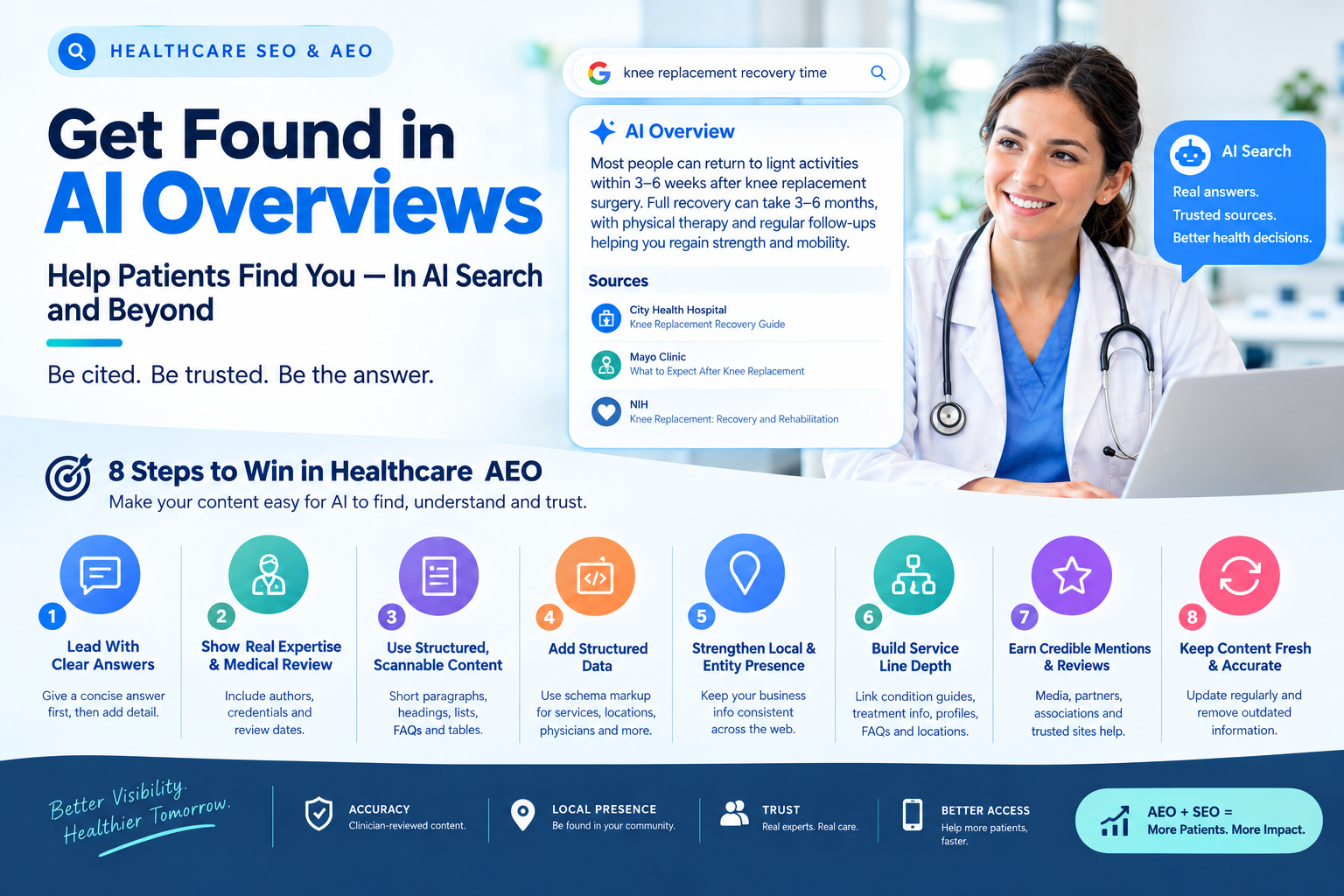
When patients search for health information today, they increasingly see an AI-generated summary at the top of the results page before any website link. These summaries, often called AI Overviews, pull together information from multiple sources and present a short answer. For hospitals and healthcare brands, this changes how visibility works. Being ranked is no longer enough. You also want your organization to be cited, trusted and recommended inside the answers that AI search tools produce.
This guide explains what healthcare AI Overviews are, why they matter for hospital SEO, how answer engine optimization (AEO) works and what practical steps healthcare organizations in the USA can take to earn visibility in AI-driven search, while keeping accuracy and compliance at the center.
What Are AI Overviews and AI Search?
AI Overviews are generated summaries that appear in some search results and answer a question directly, often with links to the sources used. Alongside them, AI assistants and chat-based search tools answer questions conversationally, sometimes recommending providers, explaining conditions or comparing options. Features, wording and availability change frequently, so healthcare marketers should monitor how search platforms handle health queries and treat any single tool's behavior as subject to change.
Why Healthcare Is a Special Case
Health topics are sensitive, and search platforms generally apply stricter quality expectations to them. Content that could affect someone's wellbeing is evaluated for accuracy, expertise, authoritativeness and trustworthiness. As a result, AI-generated answers about health tend to favor credible, well-structured sources with clear authorship and medical review. For hospitals, that is an opportunity: real clinicians, real facilities and real patient experience are advantages that generic content sites cannot easily copy.
What Is Answer Engine Optimization (AEO)?
AEO is the practice of structuring and strengthening your content so that search engines and AI assistants can understand it, trust it and use it when answering questions. It builds on traditional SEO. The foundations are the same: helpful content, a technically sound website, strong local presence and credibility signals. AEO adds a focus on clear answers, structured information and entity clarity, meaning that machines can easily tell who you are, what you treat and where you operate.
How Patients Ask Questions in AI Search
AI search encourages longer, more conversational questions. Examples include "What should I expect during knee replacement recovery?", "How do I choose between urgent care and the emergency room?" and "Which hospital near me has a cardiac rehab program?" Content that answers these questions directly, in plain language, is more likely to be useful to both readers and AI systems.
Eight Practical Steps for Healthcare AEO
1. Lead With Clear Answers
Begin each section with a concise, direct answer to the question in the heading, then add detail. For example, under "When should I go to the emergency room?" give a clear, safe summary first, then expand. Always include appropriate guidance to seek urgent care for emergencies.
2. Show Real Expertise and Medical Review
Include author names, credentials, a medical reviewer and the date content was last reviewed. Link to physician profiles. Clear human expertise supports trust for readers and for systems evaluating credibility.
3. Use Structured, Scannable Formatting
Descriptive headings, short paragraphs, lists, tables and FAQ sections make content easier to read and easier for systems to extract. Avoid burying key answers in long blocks of text.
4. Add Structured Data
Work with your web team to implement appropriate schema markup for your organization, locations, physicians, services and FAQs. Structured data helps search systems understand your entities and relationships. Keep markup accurate and consistent with visible page content.
5. Strengthen Your Local and Entity Presence
Complete and verify Google Business Profiles for every location. Keep names, addresses, phone numbers, hours and services consistent across your website and major directories. Accurate, consistent information across the web helps systems confidently identify your organization.
6. Build Service Line Depth
Create comprehensive hubs for each priority service line, linking condition guides, treatment explanations, physician profiles, FAQs and location pages together. Depth and internal linking help demonstrate topical authority.
7. Earn Credible Mentions and Reviews
Reviews, community partnerships, media coverage, professional associations and links from reputable organizations contribute to your reputation across the web. These signals support both traditional rankings and AI-driven recommendations.
8. Keep Content Fresh and Accurate
Outdated medical information can mislead patients and undermine trust. Establish a review schedule, update pages when guidelines or services change and remove obsolete content.
Content Formats That Perform Well
- Condition and procedure guides written in plain language and clinically reviewed.
- "What to expect" pages for common visits and procedures.
- Comparison and decision guides, such as urgent care versus emergency room.
- FAQ pages with short, direct answers.
- Physician and specialty profiles with clear expertise and credentials.
- Location pages with accurate hours, directions and services.
- Insurance and billing explainers that reduce confusion.
Where AI Tools Can Help Your Team
- Researching patient questions and grouping them by service line.
- Drafting outlines and first versions of content for clinical review.
- Auditing existing pages for gaps, outdated information and missing FAQs.
- Checking consistency of listings across locations.
- Summarizing performance trends and testing how your brand appears in AI-driven answers.
AI must never be the final authority on medical content. Qualified clinicians should review every clinical statement before publication.
Measuring Visibility in AI Search
Measurement is still evolving. Practical approaches include tracking organic traffic and impressions for question-style queries, monitoring branded searches, periodically testing priority questions in major AI search tools and recording whether your organization is cited or mentioned, and tracking calls, direction requests and appointment requests tied to key pages. Treat results as directional and avoid assuming any tactic guarantees inclusion in AI-generated answers.
Compliance and Ethics
- Protect patient privacy. Do not publish identifiable patient information, and review website tracking tools with your compliance team.
- Avoid misleading claims. Do not promise outcomes or make unsupported comparisons.
- Be transparent. Include disclaimers that content is educational and not a substitute for professional medical advice.
- Prioritize accessibility. Make content usable for people with disabilities and available in community languages where possible.
This article is general information, not legal or medical advice.
Common Mistakes
- Publishing unreviewed AI-generated medical content.
- Chasing tricks instead of trust. Authority, accuracy and usefulness matter most.
- Inconsistent location data. Conflicting details confuse patients and systems.
- Thin pages. Short, generic condition pages rarely earn visibility.
- Ignoring mobile and speed. Poor experience hurts engagement.
- Neglecting updates. Stale content weakens credibility.
Final Thoughts
Healthcare AI Overviews and AI search reward organizations that are clear, credible and consistent. Focus on accurate, clinician-reviewed content, strong local and entity signals and a technically sound website, and you build visibility that supports both traditional search and AI-driven discovery. If you would like help building an AEO and healthcare SEO strategy for your hospital or healthcare brand, Nova Reach Digital can help you plan and implement it.
Frequently Asked Questions
Keep reading
What Are the Top Missed-Call Text Back Setups for Clinics? Reading the Setup Table, the Five Steps and the Sample Missed-Call Follow-Up
A question-and-answer guide to the top missed-call text back setups for clinics: what it is, why missed calls cost patients, 5 setup steps, a setups table, a sample follow-up chart, texting and privacy rules and FAQs.
What Are the Top AI Chatbots for Healthcare Practices and How Do You Choose? Reading the Build Options, the Five Steps and the Sample Patient Inquiries
A question-and-answer guide to the top AI chatbots for healthcare practices: what they do, why they disappoint, 5 launch steps, a build-options table, a sample patient-inquiry chart, HIPAA and safety rules and FAQs.
What Are the Top AI Answering Services for Doctors and How Do You Choose? Reading the Service Types, the Five Steps and the Sample After-Hours Follow-Up
A question-and-answer guide to the top AI answering services for doctors: what they do, why after-hours calls get lost, 5 steps to choose, a service-types table, a sample follow-up chart, rules and FAQs.
Put These Ideas to Work with NovaReach
Automate your marketing, launch AI voice agents, and keep every lead moving, all from one dashboard.