Healthcare Chatbots: A Complete Guide for Hospitals and Healthcare Brands
A complete guide to healthcare chatbots for hospitals and healthcare brands: use cases, safety boundaries, privacy and compliance considerations, design steps and metrics for patient engagement.
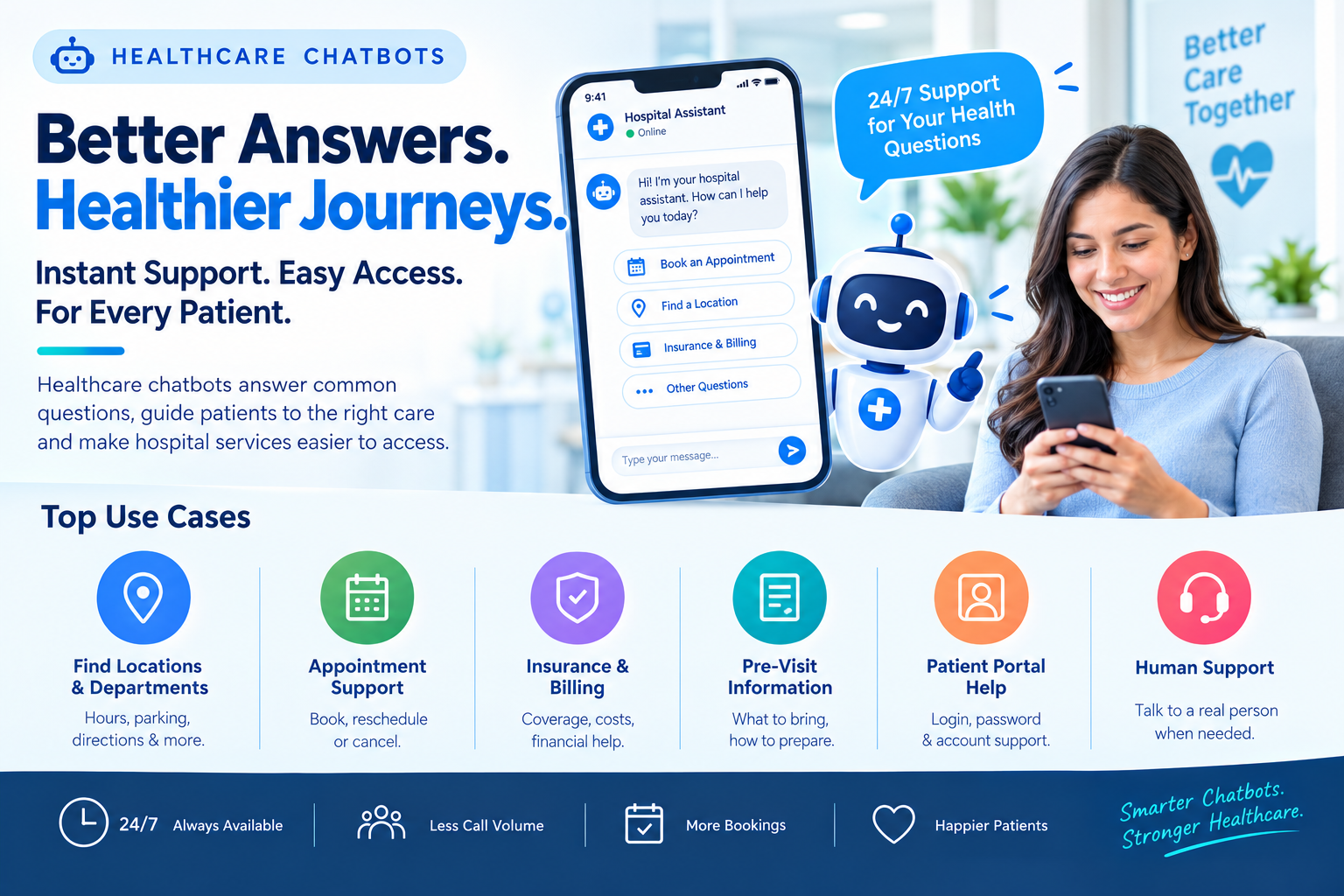
Patients expect quick answers. They want to know whether a clinic is open, how to book a visit, where to park, what insurance is accepted and how to reach the right department, and they often want those answers outside business hours. Healthcare chatbots are one of the most practical tools for meeting that expectation. Used well, a hospital chatbot can answer routine questions instantly, guide patients to scheduling and take pressure off busy front-desk and call center teams. Used poorly, it can frustrate patients or create privacy and safety risks.
This guide explains how healthcare chatbots work, where they add value in hospital marketing and patient engagement, what they should never do and how to launch one responsibly in the USA.
What Is a Healthcare Chatbot?
A healthcare chatbot is an automated assistant on a website, patient portal, messaging channel or mobile app that conversationally answers questions and completes simple tasks. Some follow fixed rules and menus. Others use AI to understand natural language and respond more flexibly. For hospitals and healthcare brands, chatbots typically focus on access and information, not clinical care.
Why Hospitals Are Adopting Chatbots
- Always available: Patients get answers at night, on weekends and during busy periods.
- Reduced call volume: Routine questions are handled without tying up staff.
- Better conversion: Website visitors who find answers quickly are more likely to book.
- Consistent information: Approved answers reduce variation between staff members.
- Multilingual support: Chatbots can serve patients in more than one language when properly configured and reviewed.
- Useful insights: Chat transcripts show what patients actually ask, which informs content and service improvements.
High-Value Chatbot Use Cases for Hospitals
1. Finding Care and Locations
Help patients find a location, department or specialist, view hours and get directions, parking details and visitor guidelines.
2. Appointment Scheduling Support
Guide patients to book, reschedule or cancel appointments for eligible visit types, or capture a request for staff to complete. Link directly to scheduling tools to reduce friction.
3. Insurance, Billing and Policy Questions
Provide general information about accepted insurance types, billing contact options, financial assistance information and records requests, with links to official pages and clear contact paths.
4. Pre-Visit Preparation
Share approved information about what to bring, how to prepare for common visits and where to find forms.
5. Lead Capture for Service Lines
Collect contact details and preferred times from visitors interested in a consultation, a screening or a program, so staff can follow up.
6. Patient Portal and Technical Help
Answer common questions about portal access, password resets and how to find information, directing sensitive account matters to secure channels.
7. Recruitment Questions
Some hospitals use chatbots to answer questions from job seekers about open roles, benefits and application steps.
What a Healthcare Chatbot Should Never Do
- Diagnose or give individual medical advice. Chatbots in a marketing or access context should not interpret symptoms or recommend treatments.
- Handle emergencies on its own. If a user describes an emergency, the chatbot should immediately advise calling 911 or going to the nearest emergency department and provide the fastest path to a human where appropriate.
- Collect more sensitive information than necessary. Avoid asking for diagnoses, detailed histories or identifiers unless the system is designed, approved and secured for that purpose.
- Pretend to be human. Be transparent that users are interacting with an automated assistant.
- Trap users in a loop. Always provide a clear way to reach a person.
Privacy and Compliance Considerations
- HIPAA and vendor agreements: If the chatbot may receive protected health information, work with your compliance and legal teams to verify that the vendor can meet the requirements and that appropriate agreements are in place.
- Website tracking: Review how chat widgets and related scripts collect data, especially on pages related to appointments, conditions or patient portals.
- Consent and notices: Provide clear notices about data collection and use, and follow rules for follow-up communications.
- Data retention and access: Decide how long transcripts are stored and who can view them.
- Accessibility: Make sure the chat experience works with screen readers and keyboard navigation and meets accessibility expectations.
This is general information, not legal advice. Consult qualified professionals.
Designing a Chatbot Patients Will Actually Use
- Start with real questions. Review call logs, front-desk notes and website search data to find the top 30 to 50 questions.
- Write approved answers. Have clinical, operational and compliance teams review every answer, and keep them short, clear and in plain language.
- Offer quick options. Buttons for common needs, such as "Find a location," "Book an appointment" and "Talk to a person," help users move fast.
- Be upfront. Open with a short greeting that explains it is an automated assistant, what it can help with and how to reach a human.
- Design emergency handling. Include clear, tested responses for emergency-related language.
- Build smooth hand-offs. Transfer to live chat, phone or a callback request with the conversation context so patients do not have to repeat themselves.
- Support multiple languages that match your community, with translations reviewed by qualified bilingual staff.
- Test extensively with staff and patient volunteers, including unusual and sensitive scenarios.
Rule-Based vs AI-Powered Chatbots
- Rule-based: Predictable and easy to control, but limited when patients phrase questions in unexpected ways.
- AI-powered: More flexible and conversational, but requires careful guardrails, approved knowledge sources and monitoring to prevent incorrect or unsafe answers.
- Hybrid: Many hospitals combine both, using rules for sensitive flows and AI for general questions drawn only from approved content.
How Chatbots Support Healthcare Marketing
A chatbot can improve the patient journey without feeling like advertising. It helps visitors find service line pages, books consultations, captures inquiries outside business hours and reveals which questions create friction. Connect chatbot data with your analytics and CRM, with privacy safeguards, to see which pages and campaigns lead to conversations and bookings. Use transcript insights to improve website content, FAQs and call center scripts.
Metrics to Track
- Number of conversations and top question categories.
- Resolution rate without human help, balanced with patient satisfaction.
- Appointment requests and bookings started in chat.
- Hand-off rate to staff and reasons.
- Patient satisfaction ratings of the chat experience.
- Reduction in repetitive call center questions.
- Safety reviews, including emergency escalation performance.
Common Mistakes
- Launching without compliance review.
- Letting AI answer from unapproved sources. Limit responses to reviewed content.
- Hiding the human option. Patients should reach a person easily.
- Skipping ongoing updates. Hours, providers and policies change.
- Measuring only deflection. A bot that deflects calls but frustrates patients does harm.
- Ignoring accessibility and language needs.
Final Thoughts
Healthcare chatbots can make care easier to find and easier to access when they are designed around real patient questions, limited to safe tasks, transparent and monitored closely. Start with a focused set of use cases, keep humans in the loop and build compliance into every step. If you would like help planning a hospital chatbot or patient engagement assistant, Nova Reach Digital can help you design, launch and improve it.
Frequently Asked Questions
Keep reading
What Are the Top Missed-Call Text Back Setups for Clinics? Reading the Setup Table, the Five Steps and the Sample Missed-Call Follow-Up
A question-and-answer guide to the top missed-call text back setups for clinics: what it is, why missed calls cost patients, 5 setup steps, a setups table, a sample follow-up chart, texting and privacy rules and FAQs.
What Are the Top AI Chatbots for Healthcare Practices and How Do You Choose? Reading the Build Options, the Five Steps and the Sample Patient Inquiries
A question-and-answer guide to the top AI chatbots for healthcare practices: what they do, why they disappoint, 5 launch steps, a build-options table, a sample patient-inquiry chart, HIPAA and safety rules and FAQs.
What Are the Top AI Answering Services for Doctors and How Do You Choose? Reading the Service Types, the Five Steps and the Sample After-Hours Follow-Up
A question-and-answer guide to the top AI answering services for doctors: what they do, why after-hours calls get lost, 5 steps to choose, a service-types table, a sample follow-up chart, rules and FAQs.
Put These Ideas to Work with NovaReach
Automate your marketing, launch AI voice agents, and keep every lead moving, all from one dashboard.