Healthcare Growth Platform: A Complete Guide for Hospitals and Healthcare Brands
A complete guide to the healthcare growth platform: core components, where AI adds value, how to evaluate options and a phased roadmap for connecting visibility, patient access, engagement and measurement.
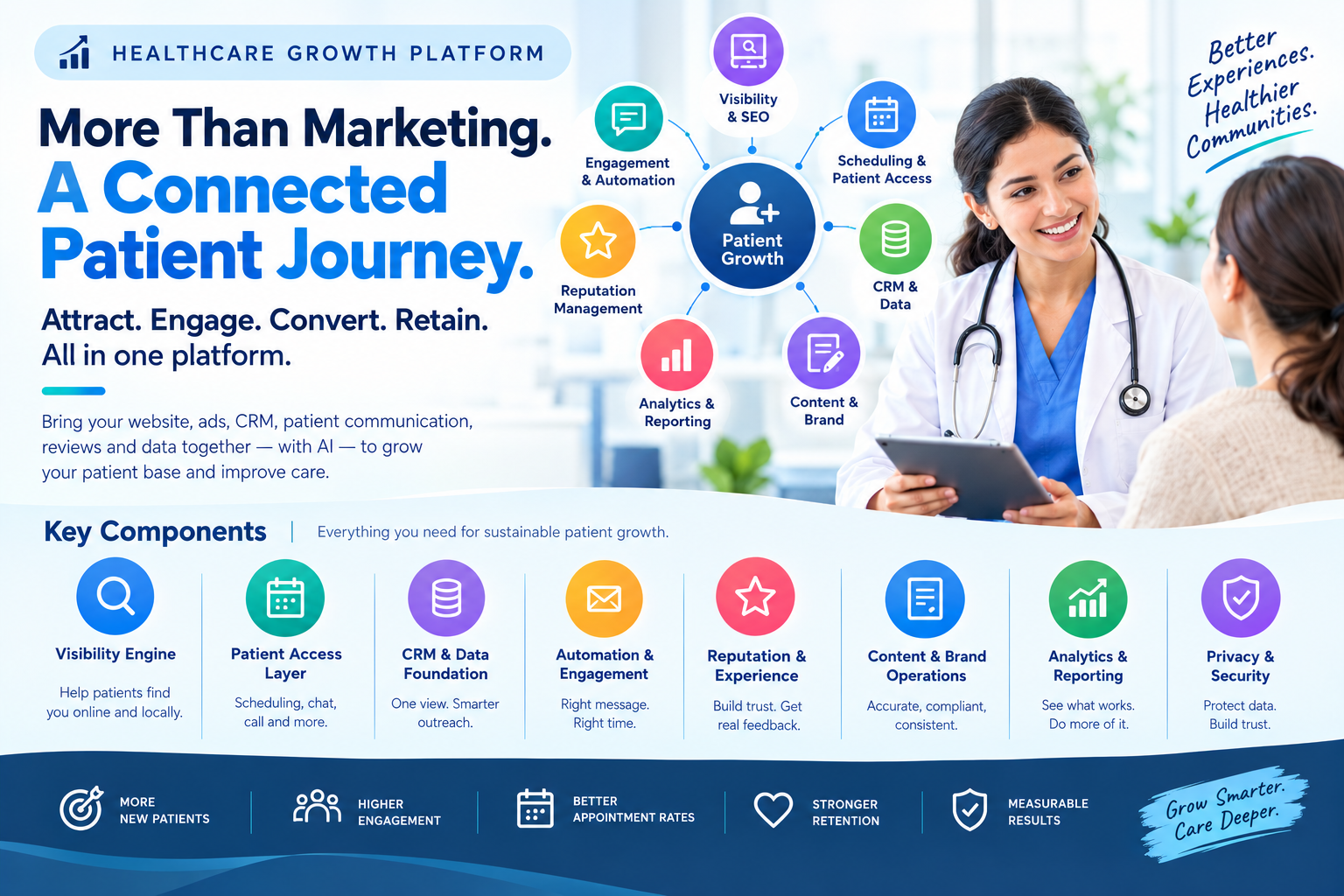
Many healthcare organizations run marketing as a collection of separate efforts: one vendor handles the website, another manages ads, an internal team sends email, a different group answers the phones and someone else tracks reviews. Each piece may work on its own, but patients experience them as a single journey. A healthcare growth platform brings those pieces together so that attracting, converting and retaining patients happens in a connected, measurable way. When AI is built in thoughtfully, it can help teams do more with the people and budgets they have.
This guide explains what a healthcare growth platform is, what components it should include, how AI fits in, how to evaluate options and how to keep privacy and patient trust at the center. It is written for hospitals and healthcare brands in the USA.
What Is a Healthcare Growth Platform?
A healthcare growth platform is a connected set of tools and workflows that supports the full patient growth cycle: awareness, inquiry, scheduling, care, retention and advocacy. Rather than treating channels in isolation, it unites data, communication and reporting so organizations can see what is working, respond faster and personalize outreach responsibly. It may be a single product, a suite or a carefully integrated combination of tools managed under one strategy.
Why Disconnected Marketing Falls Short
- Lost leads: Calls, forms and chats land in different places and some go unanswered.
- Inconsistent messaging: Different teams and vendors describe services differently.
- Blind spots: Without connected data, it is hard to know which efforts lead to appointments.
- Duplicate effort and cost: Overlapping tools and agencies waste budget.
- Patient friction: Patients may receive conflicting messages or have to repeat information.
- Compliance risk: Scattered systems make it harder to manage consent, privacy and security.
Core Components of a Healthcare Growth Platform
1. Visibility Engine
Local SEO, listings management, service line content and AI search readiness help patients find you. This includes accurate Google Business Profiles, structured content and ongoing optimization.
2. Patient Access Layer
Online scheduling, call handling, chat and AI voice assistants turn interest into appointments, with clear escalation to humans and strong accessibility.
3. CRM and Data Foundation
A unified view of contacts, preferences, consent and interaction history supports segmentation and personalization within privacy limits.
4. Automation and Engagement
Email, text, voice and portal messaging power reminders, recall, nurture sequences and follow-up, with rules that respect consent and stop automatically when patients act or opt out.
5. Reputation and Experience Management
Review monitoring, feedback requests and service recovery workflows protect reputation and identify improvement opportunities.
6. Content and Brand Operations
Workflows for planning, drafting, clinical review, compliance approval and publishing keep content accurate, consistent and timely.
7. Analytics and Reporting
Dashboards connect marketing activity to inquiries, appointments and retention by service line and location, using privacy-conscious measurement.
8. Governance, Privacy and Security
Consent management, access controls, audit trails and vendor management ensure the platform operates within your compliance requirements.
Where AI Adds Value in a Growth Platform
- Content acceleration: Research, outlines and first drafts that clinicians and editors review.
- Conversational access: Chat and voice assistants that answer routine questions, support scheduling and capture inquiries after hours.
- Lead routing and prioritization: Directing inquiries to the right team quickly.
- Personalized timing and channel: Suggesting the best way and time to reach patients who have agreed to be contacted.
- Insight generation: Summaries of reviews, calls and campaign performance that highlight patterns and opportunities.
- Workflow automation: Reducing manual tasks like data entry, reminders and report building.
AI works best as an assistant to skilled teams. Clinical content, sensitive conversations and decisions about care must remain with qualified people.
What Growth Looks Like in Healthcare
Healthcare growth is not simply more volume. Responsible growth means helping the right patients access the right care at the right time, improving continuity of care and strengthening community trust. Measures of success should include access, patient experience and retention alongside new patient numbers and revenue.
How to Evaluate a Healthcare Growth Platform
- Clarify your goals. Examples include reducing abandoned calls, improving recall completion, increasing online bookings or growing specific service lines.
- Assess current capabilities. Identify gaps in visibility, access, communication and measurement.
- Check healthcare fit. Does the provider understand healthcare workflows, compliance requirements and patient communication norms?
- Review integration. Can it connect securely with your scheduling, EHR-adjacent systems and existing tools?
- Examine privacy and security. Ask about agreements for protected health information, data storage and retention, encryption, access controls, audit logs and model training practices.
- Evaluate AI governance. How are AI outputs limited to approved information? How are emergencies and escalations handled? How is performance monitored?
- Look at reporting. Can you see clear, honest metrics tied to appointments and outcomes, not just clicks?
- Consider support and expertise. Who will manage strategy, implementation and optimization? What training is provided?
- Review flexibility and ownership. Can you export your data and content? Are contracts reasonable?
- Pilot first. Start with a service line or location and measure results before scaling.
Implementation Roadmap
- Phase 1: Audit and strategy (weeks 1 to 4). Review website, listings, reviews, call handling, CRM data and compliance posture. Define priorities and success metrics.
- Phase 2: Foundation (weeks 5 to 10). Fix listings and core pages, unify contact data, set up consent and preference tracking and implement tracking with compliance guidance.
- Phase 3: Access and automation (weeks 11 to 16). Launch scheduling improvements, call and chat support for routine needs, reminder and recall sequences and review workflows.
- Phase 4: Growth and optimization (ongoing). Expand content, test campaigns, refine automations and review performance monthly and quarterly.
Privacy, Compliance and Ethics
- Involve privacy, compliance and legal teams from the start.
- Do not send protected health information to tools without appropriate safeguards and agreements.
- Review tracking technologies and advertising practices carefully, especially around appointments, conditions and patient portals.
- Obtain and honor consent and communication preferences.
- Avoid exaggerated claims and ensure all health content is clinician-reviewed.
- Make human help easy to reach in every automated experience.
This is general information, not legal advice.
Metrics for a Healthcare Growth Platform
- New patient appointments by source, service line and location.
- Call answer rate, abandonment rate and speed to response.
- Online booking rate and appointment show rate.
- Recall completion and repeat visit rates.
- Review rating, volume and response time.
- Cost per new patient appointment, where measurable.
- Patient satisfaction and staff time saved.
Common Mistakes
- Buying a platform instead of building a strategy. Technology supports, but does not replace, clear goals.
- Underestimating change management. Teams need training and clear roles.
- Letting AI run unchecked. Human oversight is essential in healthcare.
- Chasing volume over quality of access. Marketing that drives demand without capacity creates poor experiences.
- Ignoring data quality. Inaccurate contact data undermines every campaign.
- Skipping compliance review.
Final Thoughts
A healthcare growth platform connects visibility, access, engagement and measurement so organizations can grow responsibly and serve more patients well. Start with goals and a solid data and compliance foundation, add AI where it supports your teams and measure results honestly. If you would like help planning or implementing an AI-powered growth platform for your hospital or healthcare brand, Nova Reach Digital can help you design, launch and optimize it.
Frequently Asked Questions
Keep reading
What Are the Top Missed-Call Text Back Setups for Clinics? Reading the Setup Table, the Five Steps and the Sample Missed-Call Follow-Up
A question-and-answer guide to the top missed-call text back setups for clinics: what it is, why missed calls cost patients, 5 setup steps, a setups table, a sample follow-up chart, texting and privacy rules and FAQs.
What Are the Top AI Chatbots for Healthcare Practices and How Do You Choose? Reading the Build Options, the Five Steps and the Sample Patient Inquiries
A question-and-answer guide to the top AI chatbots for healthcare practices: what they do, why they disappoint, 5 launch steps, a build-options table, a sample patient-inquiry chart, HIPAA and safety rules and FAQs.
What Are the Top AI Answering Services for Doctors and How Do You Choose? Reading the Service Types, the Five Steps and the Sample After-Hours Follow-Up
A question-and-answer guide to the top AI answering services for doctors: what they do, why after-hours calls get lost, 5 steps to choose, a service-types table, a sample follow-up chart, rules and FAQs.
Put These Ideas to Work with NovaReach
Automate your marketing, launch AI voice agents, and keep every lead moving, all from one dashboard.