Healthcare Marketing Technology: A Complete Guide for Hospitals and Healthcare Brands
A complete guide to healthcare marketing technology: the core layers of a hospital martech stack, how to choose marketing tools, where AI fits and which privacy and security questions to ask vendors.
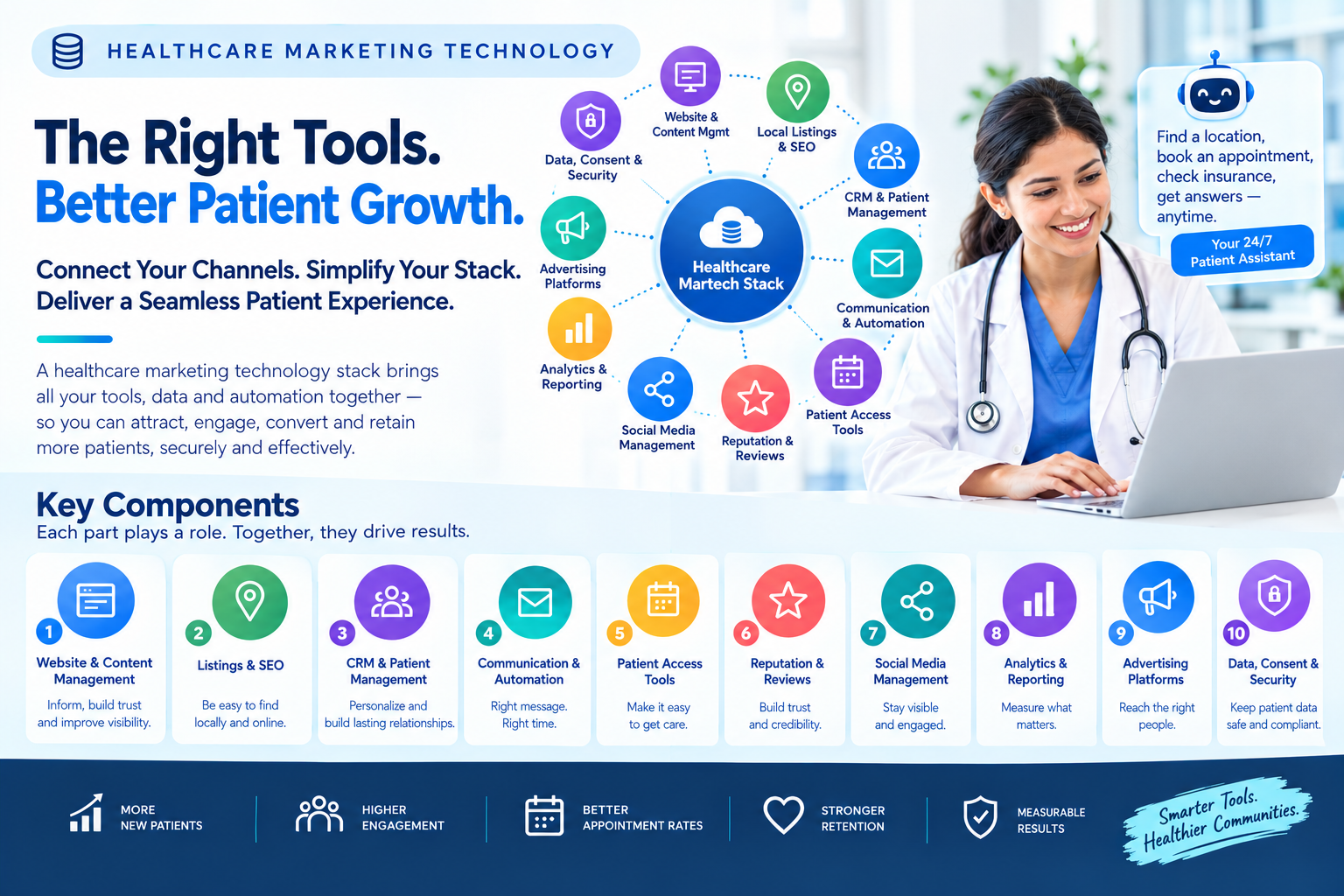
Behind every hospital website visit, appointment reminder, review request and social post sits a collection of software tools. Together, they form a healthcare marketing technology stack, often called martech. When the stack is well designed, marketing and patient access teams can reach people faster, reduce manual work and understand what is actually driving patients to book. When it is not, organizations end up with overlapping tools, disconnected data and compliance risks.
This guide explains what healthcare marketing technology includes, how to choose hospital marketing tools wisely, how AI fits into the stack and what privacy and security questions to ask. It is written for hospitals and healthcare brands in the USA.
What Is Healthcare Marketing Technology?
Healthcare marketing technology refers to the platforms and tools used to attract, engage, convert and retain patients, and to measure results. It spans the website, search and listings tools, CRM, communication platforms, analytics, reputation tools and automation systems. In healthcare, it must also meet higher standards for privacy, security and accessibility than in many other industries.
The Core Layers of a Healthcare Martech Stack
1. Website and Content Management
Your website is the center of your digital presence. A good content management system makes it easy to publish accurate service pages, physician profiles and location information, with fast load times, mobile-friendly design and strong accessibility. It should support structured data, version control and clear approval workflows for clinical content.
2. Local Listings and Search Tools
Tools that manage Google Business Profiles and online directory listings across many locations help keep names, addresses, phone numbers and hours consistent. SEO platforms support keyword research, technical audits and performance tracking.
3. CRM and Patient Relationship Management
A healthcare CRM stores contacts, preferences, consent status and communication history, and supports segmentation and campaigns. Integration with scheduling and clinical systems, done securely, allows timely, relevant outreach.
4. Communication and Automation Platforms
Email, text, voice and portal messaging tools power reminders, recall, follow-up and newsletters. Automation features let you build sequences with clear rules, such as stopping messages when a patient books or opts out.
5. Patient Access Tools
Online scheduling, call center software, call tracking, chat and AI voice assistants help convert interest into appointments. These tools directly affect patient experience and should be chosen with operational teams.
6. Reputation and Review Management
Platforms that monitor reviews across sites, send feedback requests and support compliant response workflows help manage reputation and reveal operational insights.
7. Social Media Management
Scheduling, monitoring and reporting tools support consistent posting and timely response, with approval workflows for health-related content.
8. Analytics and Reporting
Dashboards connect website activity, calls, forms and appointments to marketing sources. Healthcare organizations must configure analytics carefully to avoid collecting or sharing protected health information inappropriately.
9. Advertising Platforms
Search and social ad tools can drive awareness and inquiries but require careful targeting, messaging and policy review, particularly around sensitive health topics.
10. Data, Consent and Security Layer
Consent management, identity and access controls, audit logging and data governance tools protect patient information and support compliance.
How AI Fits Into the Stack
- Content support: Drafting, outlining and editing assistance, with clinical review.
- Conversational tools: Chatbots and voice assistants for routine questions and scheduling support.
- Personalization: Timing, channel and content suggestions within privacy limits.
- Analytics: Pattern detection, forecasting and plain-language summaries of performance.
- Operations: Review analysis, lead routing and workflow automation.
AI should be added where it solves a defined problem, not because it is fashionable. Each AI tool needs the same privacy, security and clinical oversight reviews as any other system.
How to Choose Hospital Marketing Tools
- Start with goals and problems. Define what you want to improve, such as call answer rates, recall completion or website conversion, before looking at tools.
- Map your current stack. List what you already own, how it is used, what it costs and where data flows. Many organizations discover overlapping tools.
- Involve the right stakeholders. Marketing, patient access, IT, compliance, privacy and clinical leaders should all have input.
- Evaluate integration. Tools that connect with your scheduling, CRM and analytics systems reduce manual work and data gaps.
- Assess privacy and security. Ask detailed questions, listed below.
- Consider usability. If staff will not use it, it will not deliver value. Favor clear interfaces and good training.
- Check scalability and support. Can the platform handle multiple locations, service lines and growth? What support and onboarding are provided?
- Pilot before committing. Test with one service line or location and measure results.
- Plan for ownership. Assign someone responsible for configuration, governance and ongoing optimization.
Privacy and Security Questions to Ask Every Vendor
- Will the tool create, receive, store or transmit protected health information? If so, will the vendor sign the appropriate agreement and meet required safeguards?
- Where is data stored, who can access it and how long is it retained?
- Is data encrypted in transit and at rest?
- Are there role-based access controls and audit logs?
- Is our data used to train the vendor's models or shared with third parties? Can that be prohibited?
- How are security incidents detected, reported and handled?
- Can we export and delete our data when needed?
- Has the vendor completed independent security assessments?
- Does the tool meet accessibility standards for patient-facing experiences?
Website tracking technologies deserve special attention. Review which scripts and pixels run on pages related to appointments, conditions and patient portals with your compliance and legal teams. This is general information, not legal advice.
Integration and Data Strategy
- Single source of truth: Decide which system holds the master record for contacts and preferences.
- Data quality: Clean, deduplicate and standardize data before automating outreach.
- Consent tracking: Make consent and preference status visible across tools.
- Minimum necessary data: Move only the information each tool needs.
- Documentation: Maintain a map of systems, data flows and owners.
Measuring Martech Performance
- Cost per new patient appointment and overall return on marketing investment where measurable.
- Call answer rate, speed to response and online booking rate.
- Recall completion and no-show reduction.
- Staff hours saved on manual tasks.
- Data quality indicators such as duplicate rates and contact accuracy.
- Tool adoption and satisfaction among staff.
- Total cost of ownership versus outcomes.
Common Mistakes
- Buying tools without a strategy. Technology cannot fix unclear goals.
- Stack sprawl. Too many overlapping tools create cost and confusion.
- Ignoring compliance until after purchase.
- Neglecting integration. Disconnected systems create manual work and errors.
- Underinvesting in training. Unused features are wasted money.
- No governance. Without ownership, configurations drift and risks grow.
Final Thoughts
The best healthcare marketing technology is not the longest list of tools. It is a thoughtfully connected stack that serves patients, supports staff and respects privacy. Start with goals, choose tools that integrate well and meet your compliance standards, add AI where it solves real problems and measure outcomes. If you would like help evaluating or building your healthcare marketing technology stack, Nova Reach Digital can help you plan, implement and optimize it.
Frequently Asked Questions
Keep reading
What Are the Top Email Marketing Automation Tools for Small Businesses? Reading the Tool Comparison, the Five Steps and the Sample Email Bookings
A question-and-answer guide to choosing among the top email marketing automation tools for small businesses: what they do, why programs underperform, 5 steps, a weak vs stronger table, a sample bookings chart, rules and FAQs.
What Are the Top Social Media Automation Tools for Small Businesses? Reading the Tool Comparison, the Five Steps and the Sample Posting Time
A question-and-answer guide to choosing among the top social media automation tools for small businesses: what to automate, why accounts feel robotic, 5 steps, a weak vs stronger table, a sample time-savings chart, rules and FAQs.
How Do You Choose Among the Top Digital Marketing Agencies in NYC? Reading the Agency Types, the Five Steps and the Sample Cost Per Customer
A question-and-answer guide to choosing among the top digital marketing agencies in NYC: what agencies do, why businesses switch, 5 steps to choose, an agency-types table, a sample cost-per-customer chart, rules and FAQs.
Put These Ideas to Work with NovaReach
Automate your marketing, launch AI voice agents, and keep every lead moving, all from one dashboard.