Your Lab Test Pages Deserve Better Than "Book Now": A Snippet Rewrite Guide
A practical guide for diagnostic labs on writing meta descriptions for test, package and home collection pages, with character-count tables, a sample CTR chart and a 30-day rollout plan.
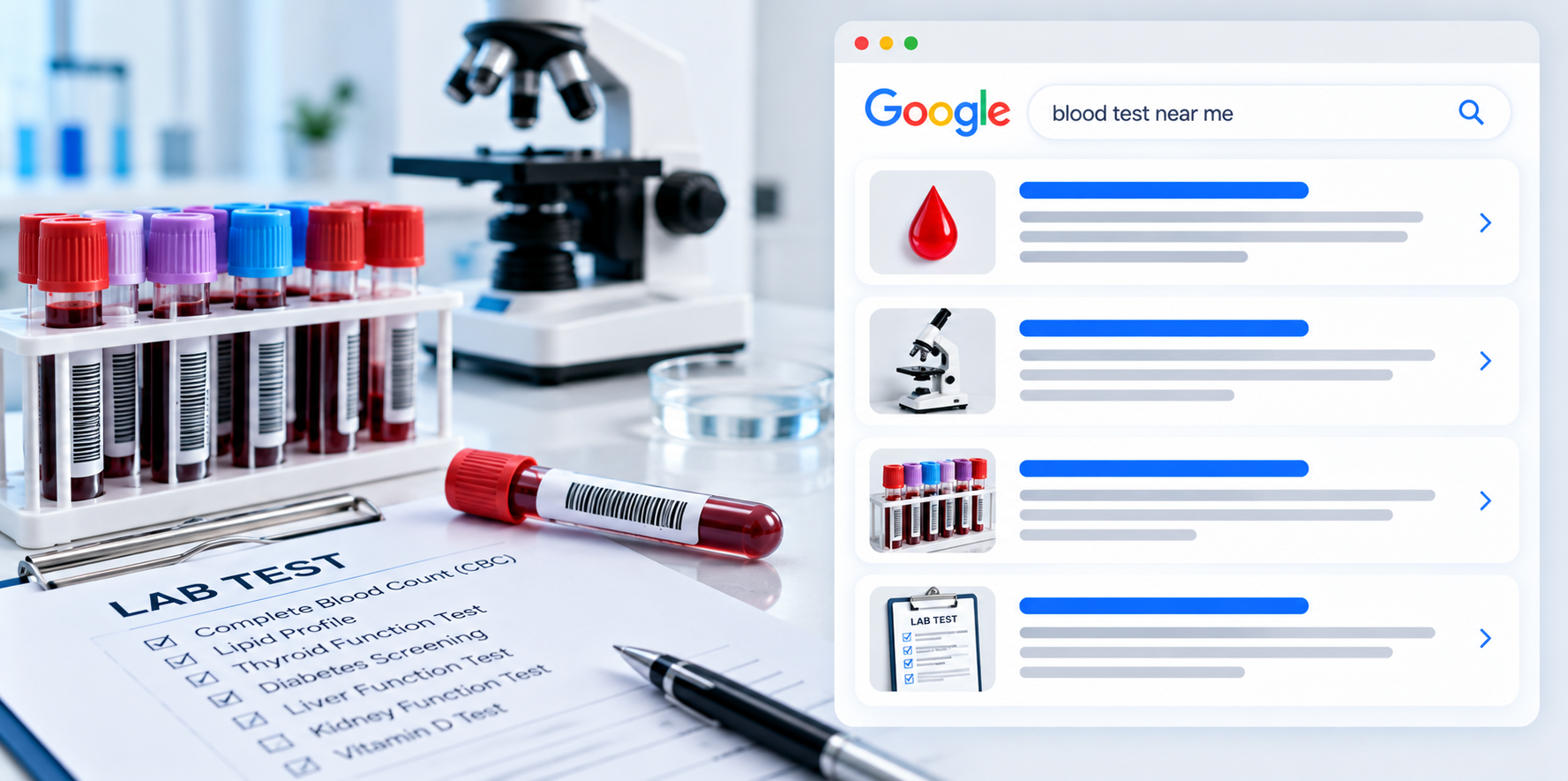
Meera runs operations at a growing diagnostic lab. One evening she searched for her own thyroid test page and felt her stomach drop. Google showed a snippet that read, "Thyroid Profile Test. Book now. Lab services." Three competitors above her explained the sample type, the report timing and the home visit option right there in the result. Her page had the same service, but her snippet said almost nothing.
That is the quiet problem with meta descriptions in diagnostics. People searching for a blood test are usually comparing, not browsing. They want to know three things fast: what the test shows, how they give the sample and how soon they get the report. A well-written meta description answers those questions before the click.
Why Meta Descriptions Matter More for Labs
A meta description is not a direct ranking factor, but it shapes the snippet people read before choosing a result, so it influences click-through rate. Google also rewrites snippets often when it feels the written one does not match the search, which is another reason to write descriptions that clearly match the page.
Diagnostic labs have an unusual challenge. You may have hundreds of near-identical test pages, so lazy templates create duplicate descriptions fast. The fix is a pattern that changes the useful details for each page type.
The Four-Part Formula for Lab Pages
- Test or service name in natural wording, near the start.
- What it shows or who needs it, in plain language, not lab jargon.
- Convenience or trust detail, such as home sample collection, accreditation you actually hold or online reports.
- Soft action, such as "Book online" or "Compare packages".
Keep roughly 120 to 155 characters. Google measures snippets in pixels, not characters, so treat these numbers as a working range rather than a fixed rule.
Page Types and What Each Description Needs
| Page type | Priority | Target length (characters) | Must include |
|---|---|---|---|
| Single test page (CBC, thyroid, HbA1c) | High | 120 to 155 | Test name, what it checks, sample type, report timing |
| Health package page | High | 120 to 155 | Who it suits, tests included, fasting instructions |
| Home collection page | High | 110 to 150 | Service area, slot booking, payment options |
| Branch or centre page | Medium | 120 to 155 | Area, opening hours, easy directions |
| Report download or login page | Low | 70 to 120 | Purpose only; often better kept out of search results |
Before and After Examples
These are sample rewrites to show the pattern. Replace the details with facts that are true for your lab.
| Page | Before | Chars | After | Chars |
|---|---|---|---|---|
| Thyroid profile | Thyroid Profile Test. Book now. Lab services. | 45 | Thyroid profile test with home sample collection. Know what TSH, T3 and T4 show and get reports online. | 102 |
| Home collection | Home Collection | City Labs | 27 | Book blood tests from home. A trained phlebotomist visits at your chosen time slot. Pay online or at collection. | 112 |
| Health packages | Health Packages | 15 | Compare full body checkup packages by age and test list. See what is included, fasting rules and price before you book. | 119 |
Notice that every "after" version is more specific, reads like a person wrote it and still ends with a gentle nudge to act.
What Improvement Can Look Like: A Sample 90-Day Test
The chart below is an illustrative example, not an industry benchmark. It shows the kind of pattern labs often see when vague snippets are rewritten: the biggest lift usually appears on high-intent pages, while utility pages barely move. Each block (█) equals 0.5% click-through rate.
| Page group | CTR before | CTR after | Relative change | Bar chart |
|---|---|---|---|---|
| Test pages | 2.1% | 3.4% | +62% | Before: ████ After: ███████ |
| Health packages | 1.8% | 3.0% | +67% | Before: ████ After: ██████ |
| Home collection | 2.6% | 4.1% | +58% | Before: █████ After: ████████ |
| Report download | 1.2% | 1.5% | +25% | Before: ██ After: ███ |
| Branch pages | 3.0% | 3.9% | +30% | Before: ██████ After: ████████ |
A 30-Day Rollout Plan
| Week | Task | Output |
|---|---|---|
| Week 1 | Export your top 20 pages by impressions from Google Search Console and note the current descriptions | Audit sheet with length and duplicates flagged |
| Week 2 | Rewrite the top 10 test pages using the four-part formula | 10 unique descriptions, reviewed by a lab or medical head |
| Week 3 | Cover packages, home collection and branch pages | 10 more descriptions, plus a reusable template per page type |
| Week 4 | Publish, then compare 28 days before and after in Search Console | CTR and impressions report per page group |
Compliance and Trust Checks
- Do not promise diagnosis, cure or "100% accurate" results. Describe what the test measures instead.
- Mention accreditations, turnaround times and prices only when they are current and verifiable.
- Avoid copying the same description across hundreds of test pages. Even a small unique detail, such as sample type or fasting need, helps.
- Re-check descriptions whenever prices, packages or service areas change.
Measuring Success
Use Search Console to compare click-through rate by page for 28 days before and after publishing. Watch impressions too: if clicks rise while impressions stay level, the snippet is doing its job. Update only the pages that have enough impressions to judge, and give each change at least three to four weeks.
The Takeaway
A diagnostic lab does not need a clever slogan in its snippet. It needs clarity: what the test shows, how easy it is to take and what happens next. Meera rewrote her top 20 pages in one month, and the next time she searched for her thyroid page, the snippet finally sounded like the lab she runs.
Frequently Asked Questions
Keep reading
What Are the Top Email Marketing Automation Tools for Small Businesses? Reading the Tool Comparison, the Five Steps and the Sample Email Bookings
A question-and-answer guide to choosing among the top email marketing automation tools for small businesses: what they do, why programs underperform, 5 steps, a weak vs stronger table, a sample bookings chart, rules and FAQs.
What Are the Top Social Media Automation Tools for Small Businesses? Reading the Tool Comparison, the Five Steps and the Sample Posting Time
A question-and-answer guide to choosing among the top social media automation tools for small businesses: what to automate, why accounts feel robotic, 5 steps, a weak vs stronger table, a sample time-savings chart, rules and FAQs.
How Do You Choose Among the Top Digital Marketing Agencies in NYC? Reading the Agency Types, the Five Steps and the Sample Cost Per Customer
A question-and-answer guide to choosing among the top digital marketing agencies in NYC: what agencies do, why businesses switch, 5 steps to choose, an agency-types table, a sample cost-per-customer chart, rules and FAQs.
Put These Ideas to Work with NovaReach
Automate your marketing, launch AI voice agents, and keep every lead moving, all from one dashboard.