Healthcare Patient Acquisition: A Complete Guide for Hospitals and Healthcare Brands
A complete guide to healthcare patient acquisition: how hospitals and healthcare brands use digital marketing, local SEO, content, paid search and nurturing to generate qualified leads responsibly and measure results.
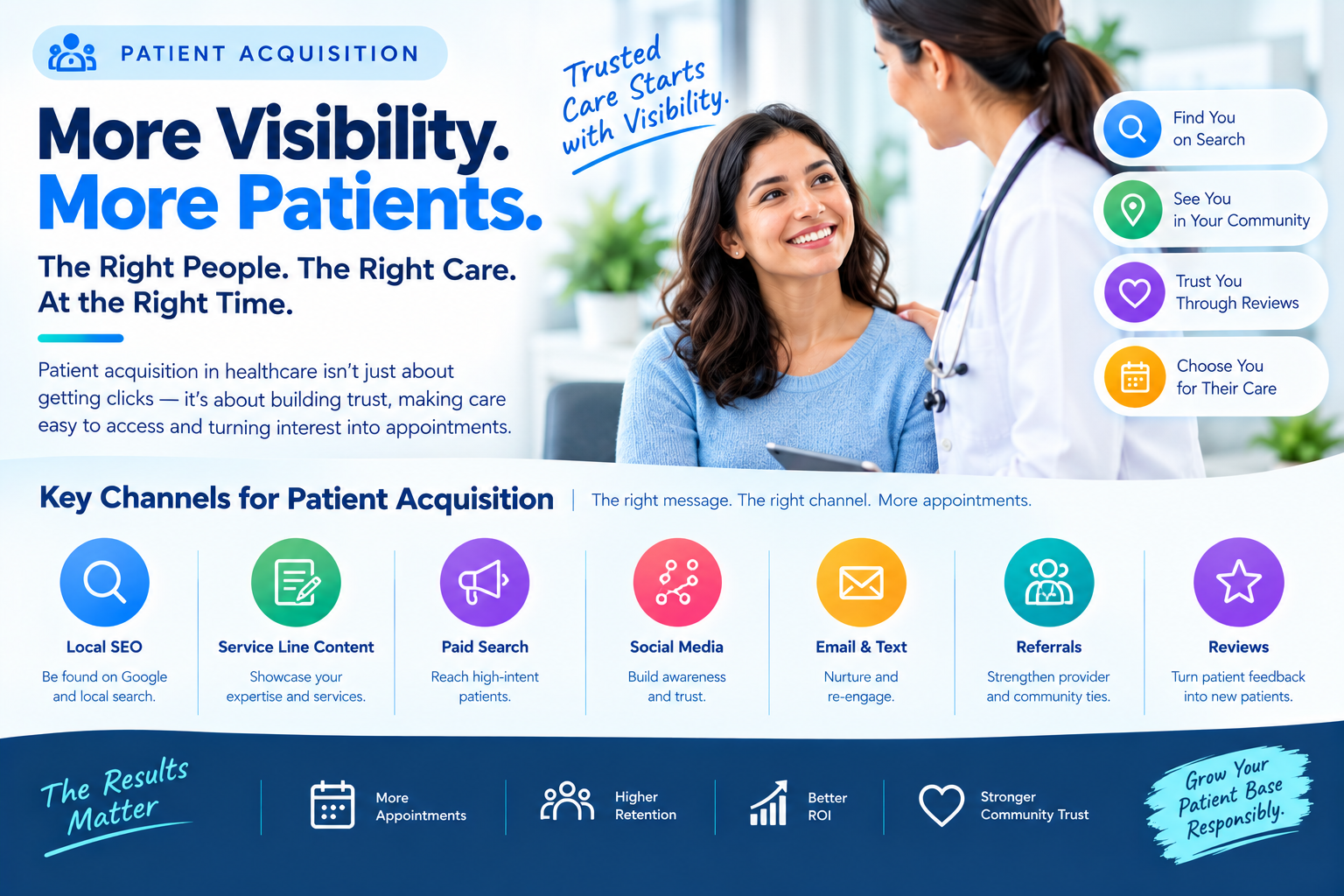
Every hospital and healthcare brand wants to reach the patients who need its services. But patient acquisition in healthcare is different from selling a product. People choose providers based on trust, convenience, insurance, location, referrals and often urgency. Digital marketing has become central to that decision, from the first search to the first phone call. A strong patient acquisition strategy helps new patients find you, feel confident in choosing you and book without friction, while staying within privacy, advertising and ethical boundaries.
This guide explains how hospitals, clinics and healthcare brands in the USA can build a patient acquisition strategy with digital marketing, generate qualified healthcare leads responsibly and measure what works.
What Is Patient Acquisition in Healthcare?
Patient acquisition is the process of attracting, engaging and converting new patients to your organization. It spans digital channels such as search, maps, websites, social media and email, as well as offline sources such as referrals, community events and partnerships. It is closely tied to patient access: even the best marketing fails if scheduling is slow, calls go unanswered or information is unclear.
How Patients Choose Providers
- Search and maps: Many start with a search for a condition, service or "near me" provider.
- Recommendations: Primary care providers, family and friends strongly influence decisions.
- Reviews and reputation: Ratings and comments shape trust.
- Insurance and cost: Network participation and billing clarity often decide the choice.
- Convenience: Location, availability, telehealth options and ease of scheduling matter.
- Perceived expertise and compassion: Physician profiles, credentials and the tone of communication influence confidence.
Core Channels for Healthcare Patient Acquisition
1. Local SEO and Google Business Profile
For location-based care, local search is often the highest-intent channel. Keep every Google Business Profile complete and accurate, maintain consistent listings, create unique location pages and build reviews. Patients searching for urgent care, primary care, specialists and imaging often act quickly on what they find first.
2. Service Line SEO and Content
Create in-depth, clinician-reviewed pages for each priority service line: conditions treated, treatment options, what to expect, providers and how to schedule. Add helpful educational content that answers real patient questions. Content builds trust, and trust supports acquisition.
3. Paid Search
Search ads can capture demand for service-related queries, such as a specific procedure or specialty near a location. Use clear, accurate messaging and dedicated landing pages with easy booking. Be careful about claims and about advertising related to sensitive conditions. Review platform policies for healthcare advertising and consult compliance before launching.
4. Social Media and Community Presence
Social channels support awareness, trust and community connection. Use them to introduce providers, share health education, promote events and highlight services, with consent for any patient content and clinician review for health information.
5. Email and Text Nurturing
For people who have shown interest, consent-based email and text follow-up helps bring them back to schedule. Newsletters and educational series keep your organization top of mind without aggressive selling.
6. Physician Referral Marketing
Many specialty patients arrive by referral. Provide referring providers with clear information, easy referral forms, timely communication and updates. A strong digital presence supports referral relationships by making it easy to verify your services and credentials.
7. Reputation and Reviews
Reviews affect both local rankings and patient choice. Make it easy for satisfied patients to share feedback, respond professionally without revealing patient information and use feedback to improve operations.
8. Community and Partnership Outreach
Screenings, health fairs, employer partnerships and local sponsorships build trust and reach people who may not be searching online yet.
Generating Healthcare Leads Responsibly
A healthcare lead is typically a person who has asked for information, a callback or an appointment. Responsible lead generation means:
- Be transparent. Make clear what happens when someone submits a form or calls.
- Collect only what you need. Avoid asking for sensitive health details on public forms unless the system is designed and approved for it.
- Respect consent. Follow rules for email, text and phone outreach, and honor opt-outs.
- Avoid pressure and misleading claims. Do not promise outcomes or use fear-based messaging.
- Follow advertising and referral rules. Healthcare has legal restrictions on certain incentives, referrals and marketing practices, so consult legal counsel.
This is general information, not legal advice.
Make Conversion Easy: The Patient Access Layer
Marketing creates demand, but access converts it. Review these basics:
- Speed to response: Respond to online inquiries and missed calls quickly.
- Call handling: Reduce hold times and abandoned calls with staffing, call routing and AI call answering for overflow and after-hours.
- Online scheduling: Let patients book directly where appropriate.
- Mobile experience: Fast pages, click-to-call buttons and simple forms.
- Insurance clarity: Provide understandable information on accepted plans and how to verify coverage.
- Language and accessibility: Offer translation support and accessible tools.
Where AI Supports Patient Acquisition
- Content research and drafting: Identify patient questions and create first drafts for clinical review.
- Call and chat assistants: Answer routine questions and help patients start scheduling.
- Lead routing and follow-up: Send inquiries to the right team and trigger consent-based reminders.
- Analytics and reporting: Connect marketing sources to appointments by service line.
- Review monitoring: Alert staff to new reviews and draft replies for approval.
AI should support staff, not replace clinical judgment, and sensitive interactions should remain with trained people.
A Practical 90-Day Patient Acquisition Plan
- Days 1 to 30: Foundation. Audit your website, listings, reviews, call handling and scheduling. Choose two or three priority service lines. Set up call tracking and conversion tracking with compliance guidance.
- Days 31 to 60: Visibility. Optimize Google Business Profiles and location pages, publish or improve service line pages, launch review requests and begin a small, carefully reviewed paid search test.
- Days 61 to 90: Conversion and nurture. Add consent-based follow-up sequences, improve landing pages and scheduling flows, strengthen referral communication and review results by service line to decide where to invest more.
Metrics That Matter
- New patient appointments by service line and source.
- Calls, direction requests and form submissions.
- Cost per new patient appointment, where measurable.
- Call answer rate and speed to response.
- Appointment show rate.
- Review volume, rating and response time.
- Patient lifetime relationship indicators such as repeat visits and referrals, where available.
Measure carefully and in line with privacy rules. Avoid sending protected health information to analytics or advertising platforms without proper safeguards and agreements.
Common Mistakes
- Driving traffic without fixing access. Slow scheduling wastes marketing spend.
- Ignoring compliance in tracking and advertising.
- Using generic messaging. Patients respond to clarity, empathy and relevance.
- Neglecting referrals. Referral sources are often the most valuable channel.
- Underinvesting in reviews and reputation.
- Measuring clicks instead of appointments. Tie results to real patient outcomes for your organization.
Final Thoughts
Healthcare patient acquisition works best when digital marketing and patient access work together: visible, trustworthy information on one side, and fast, easy scheduling on the other. Build a foundation in local SEO and content, add carefully managed paid and social channels, nurture with consent and measure by appointments. If you would like help building a patient acquisition strategy for your hospital or healthcare brand, Nova Reach Digital can help you plan, launch and optimize it responsibly.
Frequently Asked Questions
Keep reading
What Are the Top Missed-Call Text Back Setups for Clinics? Reading the Setup Table, the Five Steps and the Sample Missed-Call Follow-Up
A question-and-answer guide to the top missed-call text back setups for clinics: what it is, why missed calls cost patients, 5 setup steps, a setups table, a sample follow-up chart, texting and privacy rules and FAQs.
What Are the Top AI Chatbots for Healthcare Practices and How Do You Choose? Reading the Build Options, the Five Steps and the Sample Patient Inquiries
A question-and-answer guide to the top AI chatbots for healthcare practices: what they do, why they disappoint, 5 launch steps, a build-options table, a sample patient-inquiry chart, HIPAA and safety rules and FAQs.
What Are the Top AI Answering Services for Doctors and How Do You Choose? Reading the Service Types, the Five Steps and the Sample After-Hours Follow-Up
A question-and-answer guide to the top AI answering services for doctors: what they do, why after-hours calls get lost, 5 steps to choose, a service-types table, a sample follow-up chart, rules and FAQs.
Put These Ideas to Work with NovaReach
Automate your marketing, launch AI voice agents, and keep every lead moving, all from one dashboard.