HIPAA-Conscious AI Marketing and Automation: A Privacy and Compliance Guide for Hospitals and Clinics
A plain-language guide to privacy and compliance for AI marketing and automation in healthcare: PHI basics, vendor checklists, tracking technology risks, AI voice agents and governance steps for hospitals and clinics.
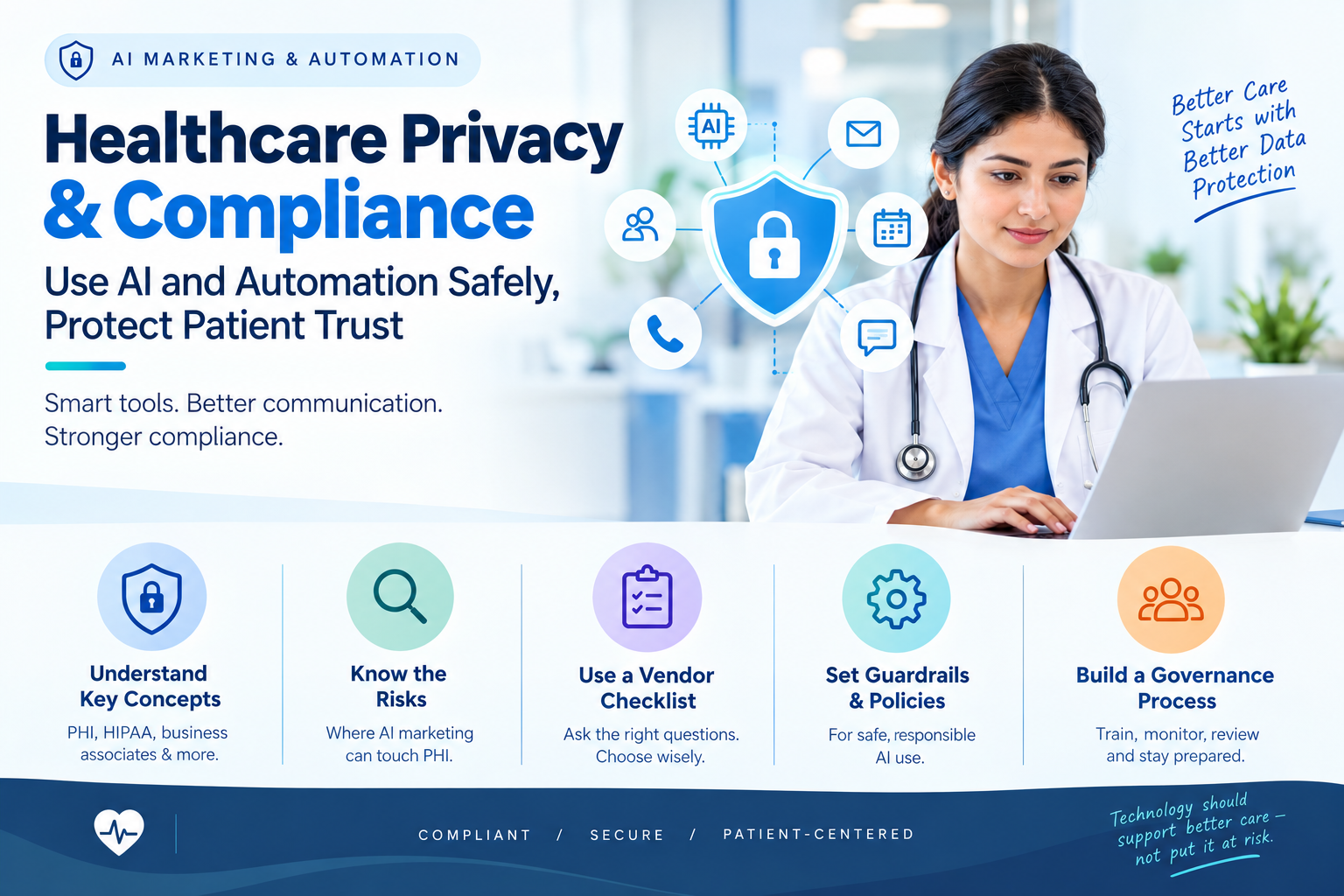
Hospitals and clinics hold some of the most sensitive information that exists: diagnoses, treatments, medications, insurance details and family history. Marketing teams, patient access teams and outside vendors increasingly want to use AI and automation to improve communication, scheduling and outreach. These tools can be valuable, but in healthcare they come with serious responsibility. A careless workflow can expose protected health information, violate patient trust and create legal and financial risk.
This guide offers a practical, plain-language overview of how healthcare organizations in the USA can think about privacy and compliance when using AI marketing and automation. It is general information, not legal advice. Always consult your privacy officer, compliance team and qualified legal counsel before deploying any new tool or workflow.
Why Healthcare Marketing Compliance Is Different
In most industries, customer data is valuable but not especially dangerous to share. In healthcare, even simple facts can be sensitive. Knowing that a person visited a particular clinic, searched for a specific condition or signed up for a certain service can reveal health information. Marketing and automation tools that track visitors, collect form submissions, record calls or send messages can therefore touch protected information in ways that are easy to overlook.
Key Concepts in Plain Language
- Protected health information (PHI): Individually identifiable health information held or transmitted by covered entities and their business associates, in any form. It can include names, contact details, appointment details, diagnoses and more when linked to a patient.
- HIPAA: The federal law that sets privacy and security standards for protected health information and applies to covered entities such as many providers and health plans, and to their business associates.
- Business associate: A vendor or partner that creates, receives, maintains or transmits PHI on behalf of a covered entity. These relationships typically require a written agreement.
- Minimum necessary: The principle of using or sharing only the information needed for a specific purpose.
- Consent and authorization: Permission from the individual that may be required for certain uses of information, including some marketing activities.
How these concepts apply to your organization depends on your role, your activities and your jurisdiction, so professional guidance is essential.
Where AI Marketing Can Touch PHI
- Website tracking and analytics: Tools that collect visitor data on patient portals, appointment pages or condition-specific pages may capture identifiers and health-related behavior. Regulators have raised concerns about tracking technologies on healthcare websites, so review your setup carefully with qualified advisors.
- Forms and chatbots: Contact forms, symptom-related questions and chat conversations may include health details.
- Call recording and AI voice agents: Calls often include names, dates of birth, reasons for visits and other PHI.
- Text and email platforms: Messages and logs may contain appointment details and patient identifiers.
- CRM and patient lists: Lists used for outreach or advertising may contain PHI.
- Advertising audiences: Uploading patient lists or building audiences based on health conditions can create privacy risks.
- Generative AI tools: Entering PHI into tools that are not approved and properly protected can result in impermissible disclosures.
A Practical Vendor Checklist
Before adopting any AI marketing or automation vendor, work with your compliance team to ask:
- Will this tool create, receive, store or transmit PHI? If so, is the vendor willing to sign the appropriate agreement and meet security requirements?
- Where is data stored, who can access it and how long is it retained?
- Is data encrypted in transit and at rest?
- Does the vendor use our data to train its models or share it with third parties? Can that be disabled or prohibited by contract?
- What access controls, audit logs and monitoring are available?
- How are security incidents detected and reported?
- Can we delete data on request and at the end of the relationship?
- Does the tool integrate safely with our scheduling systems and electronic health record?
- Has the vendor undergone independent security assessments?
Guardrails for Specific Tools
Website Analytics and Advertising Pixels
Review which tracking tools are installed, what data they collect and whether they appear on pages that relate to appointments, conditions, treatments or patient portals. Work with legal counsel to decide what is appropriate, and consider limiting or configuring tracking on sensitive pages.
AI Voice Agents and Chat Assistants
Disclose that callers or visitors are interacting with an automated assistant. Limit what the assistant collects to what is necessary, define identity verification rules, set emergency escalation procedures and avoid medical advice. Confirm recording, retention and consent practices comply with applicable laws.
Email and Text Messaging
Keep messages minimal, avoid sensitive details and use secure portals for clinical information. Obtain and document consent where required and honor opt-outs promptly.
Generative AI for Content
Do not enter PHI into general-purpose AI tools unless your organization has approved the tool and the necessary protections and agreements are in place. Use de-identified or fictional examples when drafting. Have clinicians verify all medical content.
Patient Testimonials and Stories
Obtain proper written authorization before sharing any identifiable patient story, image or video, and make sure the authorization covers the specific use.
Building an Internal AI and Marketing Governance Process
- Create an inventory of marketing and automation tools, what data they touch and who owns them.
- Set an approval process. New tools and workflows should be reviewed by compliance, privacy and security teams before launch.
- Write clear policies on acceptable AI use, including what information may never be entered into AI tools.
- Train staff and vendors. Make sure everyone understands what is allowed and how to report concerns.
- Log and monitor. Keep records of approvals, vendor agreements and incidents.
- Review regularly. Laws, platform policies and technologies change, so reassess at least annually.
- Prepare an incident response plan that includes marketing tools and vendors.
Ethical Considerations Beyond the Law
- Transparency: Tell patients when they are interacting with AI and how their information is used.
- Fairness and access: Make sure automation does not disadvantage people with limited technology access, language barriers or disabilities.
- Human oversight: Keep qualified people responsible for clinical content and sensitive interactions.
- Trust: A single privacy mistake can undermine years of reputation, so favor caution when in doubt.
Common Mistakes to Avoid
- Adopting tools before a compliance review.
- Assuming a vendor is compliant because it says so. Verify agreements and safeguards.
- Pasting patient information into public AI tools.
- Installing tracking pixels everywhere without review.
- Including sensitive details in texts, emails or voicemails.
- Forgetting that vendors are part of your risk. Their mistakes can become your incident.
Final Thoughts
AI marketing and automation can help healthcare organizations communicate better, reduce administrative burden and make care easier to access. The foundation is trust, and trust depends on thoughtful privacy and compliance practices. Start with a governance process, vet vendors carefully, limit the data you collect and keep qualified people involved. If you would like help designing AI-powered marketing and automation workflows that are built around your compliance team's requirements, Nova Reach Digital can work with you to plan and implement them responsibly.
Frequently Asked Questions
Keep reading
What Are the Top Missed-Call Text Back Setups for Clinics? Reading the Setup Table, the Five Steps and the Sample Missed-Call Follow-Up
A question-and-answer guide to the top missed-call text back setups for clinics: what it is, why missed calls cost patients, 5 setup steps, a setups table, a sample follow-up chart, texting and privacy rules and FAQs.
What Are the Top AI Chatbots for Healthcare Practices and How Do You Choose? Reading the Build Options, the Five Steps and the Sample Patient Inquiries
A question-and-answer guide to the top AI chatbots for healthcare practices: what they do, why they disappoint, 5 launch steps, a build-options table, a sample patient-inquiry chart, HIPAA and safety rules and FAQs.
What Are the Top AI Answering Services for Doctors and How Do You Choose? Reading the Service Types, the Five Steps and the Sample After-Hours Follow-Up
A question-and-answer guide to the top AI answering services for doctors: what they do, why after-hours calls get lost, 5 steps to choose, a service-types table, a sample follow-up chart, rules and FAQs.
Put These Ideas to Work with NovaReach
Automate your marketing, launch AI voice agents, and keep every lead moving, all from one dashboard.