What Mistakes Do New York Businesses Make When Adopting AI Marketing Automation? Reading the Cited Failure Rates, the Named Causes and the Review Gaps
One cited figure, 85% of AI projects failing on data quality, and five named causes with no rate attached. What the published record on AI marketing mistakes measures.
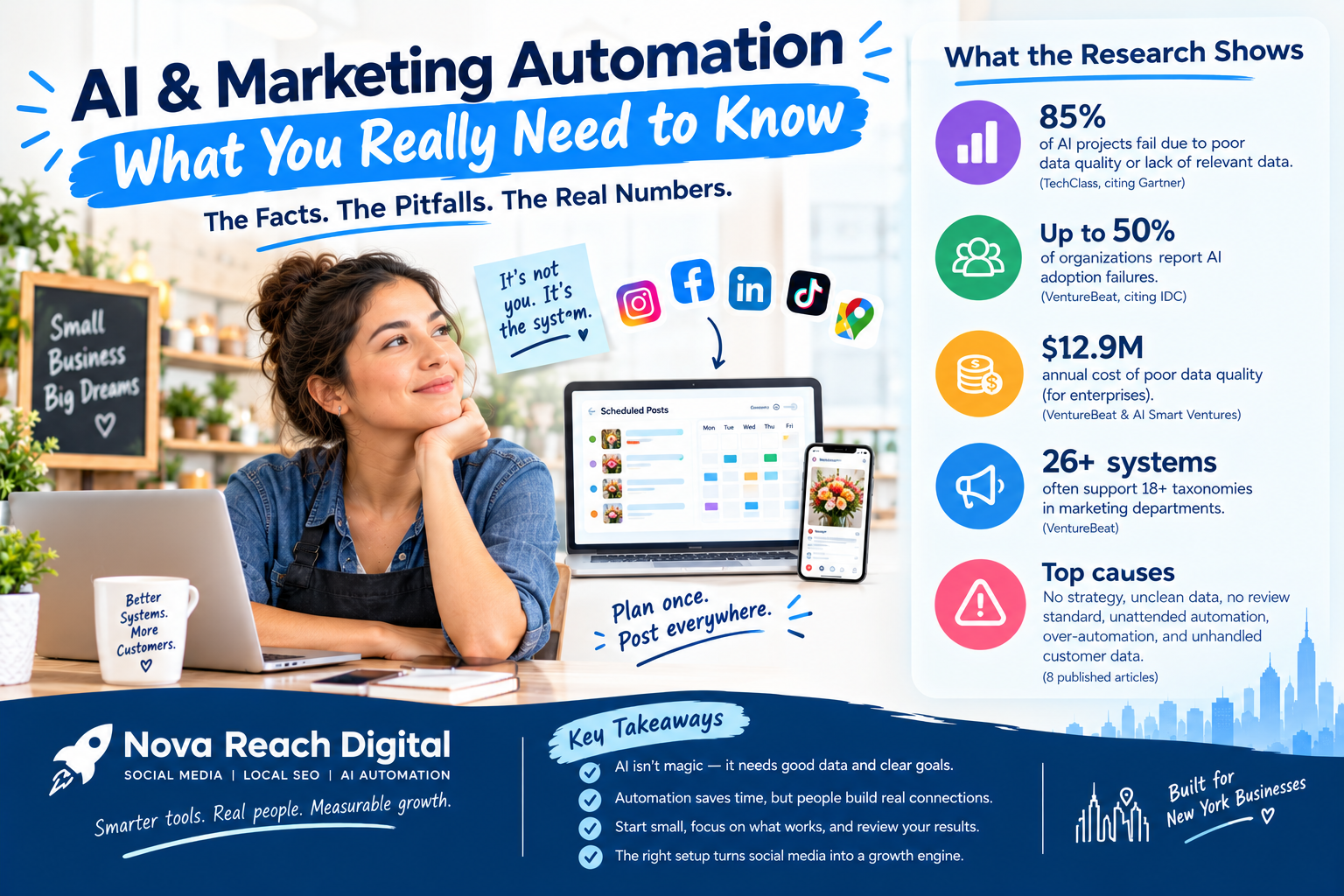
The failure rates quoted about AI projects are repeated far more often than they are measured for marketing automation at small businesses. The most-cited figure, that 85% of AI projects fail because of poor data quality or missing data, appears in a TechClass explainer that attributes it to Gartner, and the text read for this report does not link a primary source for it. The causes named across eight published articles are narrower and more consistent: no stated goal, unclean data, no review standard, unattended operation, over-automation and unexamined handling of customer data. None of the articles measures New York businesses, and none reports a failure rate for small-business marketing automation specifically.
Key Findings
- TechClass reports that 85% of AI projects fail due to poor data quality or lack of relevant data, attributing the figure to Gartner. It covers AI projects in general, not marketing automation.
- A VentureBeat article citing IDC reports that a quarter of organizations attempting to adopt AI report up to a 50% failure rate. The article is older than the other sources, and it assumes without measuring that marketing departments would fail more often.
- The same $12.9 million annual cost of poor data quality is attributed to Gartner by VentureBeat and to IBM by AI Smart Ventures. The two attributions are not reconciled here.
- VentureBeat describes marketing departments running 26 or more systems supporting 18 or more taxonomies, built one campaign at a time.
- 4Thought Marketing names launching without a defined strategy, sending to unsegmented or dirty data, ignoring unsubscribes and skipping pre-launch testing as the most common marketing automation mistakes.
- PC Tech Magazine and 4Thought Marketing both name the absence of a review standard for AI output as a mistake. Neither reports a measured rate for it.
What failure rate is attached to AI projects, and who measured it?
Two figures circulate, and they do not measure the same thing. TechClass reports that 85% of AI projects fail because of poor data quality or lack of relevant data, attributed to Gartner. A VentureBeat article citing IDC reports that a quarter of organizations attempting to adopt AI report an up to 50% failure rate. The first counts projects and names a cause. The second counts organizations and gives a ceiling.
Neither is a marketing figure. VentureBeat's own text notes that its survey was at the organization level and then says it would not be a stretch to assume the rate is higher inside marketing departments. That is an assumption stated by the author, not a measurement.
Source: TechClass, 2026, citing Gartner; VentureBeat, citing IDC.
The record does not contain a failure rate for small businesses adopting marketing automation, and it contains no New York figure at all.
Is the absence of a strategy the most-named cause?
It is the first cause listed in most of the articles. PC Tech Magazine's September 2026 article says businesses often get poor results because they automate tasks before setting goals, checking data, defining review standards or assigning responsibility. 4Thought Marketing lists launching programs without a defined strategy first among foundational mistakes, and says automation fails most often before the first email sends.
The mechanism the articles describe is consistent. Without a stated direction, AI produces more activity without showing whether the activity supports revenue or customer acquisition. The articles present this as a pattern they observe in client work, and none of them cites a sample or a rate.
Source: PC Tech Magazine, 2026; 4Thought Marketing, 2026.
What does "poor data" mean in the marketing sources?
The marketing sources describe it as inconsistency more than as error. VentureBeat reports marketing departments with 26 or more systems supporting 18 or more taxonomies, each created to support a specific campaign, and names the lack of consistency across campaigns as the most common reason AI and machine learning fail in marketing.
4Thought Marketing states the principle plainly: automation platforms amplify whatever data they are given. It adds an AI-specific version. A lead-scoring model trained on historical data that reflects old qualification criteria can lose quality without anyone noticing, because the output still looks like a score.
The cost figure attached to bad data is itself contested in attribution. VentureBeat attributes up to $12.9 million per year for a typical enterprise to Gartner, and AI Smart Ventures attributes $12.9 million to IBM. Both describe enterprises, not small businesses.
Source: VentureBeat; 4Thought Marketing, 2026; AI Smart Ventures, 2026.
What do the articles say about unattended automation?
Two articles name it directly. PC Tech Magazine lists treating AI as a set-and-forget system among the common mistakes, and 4Thought Marketing calls the biggest AI-era mistake using AI to generate content or score leads without establishing review standards or auditing the outputs.
PC Tech Magazine adds that AI-generated content can contain incorrect facts, unsupported claims, awkward wording or language that conflicts with brand standards. TechClass makes a related point from the technical side: models do not work at full accuracy from day one and usually need continuing tuning with quality data.
Source: PC Tech Magazine, 2026; 4Thought Marketing, 2026; TechClass, 2026.
These are descriptions of what can go wrong. None of the three reports how often it does.
Does over-automation show up in measured data?
Not in the text read here. Agility Portal states that over-automation without human oversight reduces trust and weakens brand differentiation, and that AI tends to standardize tone. 4Thought Marketing lists over-automated journeys among the newer AI-era mistakes. Neither source reports a survey, a conversion difference or a customer-trust measurement behind the claim.
It is therefore a claim about a mechanism, made by practitioners, and it sits in the record as an assertion.
Source: Agility Portal, 2026; 4Thought Marketing, 2026.
What do the sources say about consent and customer data?
Three articles raise it, in different terms. Online Marketing Muscle names GDPR and the California Consumer Privacy Act as regimes small businesses are expected to follow, and says small businesses often assume they will not be noticed. BusinessPlusAI describes companies processing personal data in AI tools without proper consent mechanisms, or moving customer data to AI platforms without adequate data protection agreements. 4Thought Marketing advises against giving AI marketing tools confidential or sensitive data.
The articles name regimes from other jurisdictions and none identifies a New York statute. This report does not assess what the law requires of a New York business.
Source: Online Marketing Muscle, 2026; BusinessPlusAI, 2026; 4Thought Marketing, 2025.
What does each named mistake rest on?
| Named mistake | How the sources describe it | What is measured |
|---|---|---|
| No strategy before launch | Automating before goals, data checks and ownership exist | No rate reported |
| Poor or inconsistent data | 26 or more systems, 18 or more taxonomies; platforms amplify what they receive | 85% of AI projects, attributed to Gartner via TechClass; not marketing-specific |
| No review of AI output | Content and lead scores used without audit | No rate reported |
| Set-and-forget operation | Workflows not updated as offers and questions change | No rate reported |
| Over-automation | Reduced trust and standardized tone | No rate reported |
| Consent and data handling | Personal data processed without safeguards | No rate reported |
Source: TechClass, 2026; VentureBeat; 4Thought Marketing, 2026; PC Tech Magazine, 2026; Agility Portal, 2026; Online Marketing Muscle, 2026; BusinessPlusAI, 2026.
Methodology and limitations
This report reads eight published articles and measures what they state, not what happens to businesses that adopt AI marketing automation.
All sources are trade, vendor or consultancy publications. None is peer-reviewed, and none samples New York businesses. The 85% Gartner figure and the IDC figure are cited secondhand and were not read at the original. The VentureBeat article is several years older than the others, so its figures predate the current generation of tools. The $12.9 million figure carries two different attributions in the sources read, and this report states both and does not choose.
The causes listed here are the ones the articles name. A correlation between a named mistake and a poor result is not shown in any of them, and the table reports where a figure exists and where none does. Nothing here is a recommendation about whether to adopt AI marketing automation.
Conclusion
What mistakes do New York businesses make when adopting AI marketing automation? The published record names six, and it supports them unevenly. Only one, poor data, has a number attached, and that number describes AI projects in general and arrives through a secondary citation. The other five, including missing strategy, unreviewed output and over-automation, are descriptions from practitioners who report what they see without a sample or a rate. They agree with one another closely, which is a finding about the articles. Is agreement among sources that never measured the problem the same thing as evidence that it happens at the rate they imply?
Sources
- 4Thought Marketing, 2025. Avoiding Common AI Marketing Mistakes. 4thoughtmarketing.com. Consultancy article.
- 4Thought Marketing, 2026. Marketing Automation Mistakes to Avoid. 4thoughtmarketing.com. Consultancy article.
- Agility Portal, 2026. Why Most AI Marketing Strategies Fail, and How to Fix Yours Fast. agilityportal.io. Vendor article.
- AI Smart Ventures, 2026. Why AI Adoption Fails: The Top Mistakes Growing Businesses Make. aismartventures.com. Consultancy article.
- BusinessPlusAI, 2026. 10 AI Marketing Mistakes That Are Costing You Revenue. businessplusai.com. Vendor article.
- Online Marketing Muscle, 2026. Top 10 AI Mistakes Small Businesses Make. onlinemarketingmuscle.com. Agency article.
- PC Tech Magazine, 2026. Common Mistakes Businesses Make When Using AI for Marketing. pctechmag.com. Trade publication.
- TechClass, 2026. Avoiding Costly AI Adoption Mistakes in Business. techclass.com. Vendor article citing Gartner.
- VentureBeat. Is Poor Data Quality Undermining Your Marketing AI? venturebeat.com. Trade publication citing IDC and Gartner.
Frequently Asked Questions
Keep reading
AI Receptionist for New York Small Businesses: How AI Call Answering and Missed-Call Automation Capture Every Lead
Quick answer on AI receptionists: how AI call answering, missed-call automation and AI appointment booking help New York small businesses capture every lead, plus setup steps and compliance tips.
Google Business Profile Optimization for New York Businesses: 9 Steps to Rank on Google Maps and in AI Answers
Quick answer and 9-step checklist for Google Business Profile optimization in New York: categories, reviews, photos, posts, plus how to get cited in Google AI, ChatGPT and other answer engines.
Automated Social Media Posting: A Practical Playbook for New York Small Businesses
Posting every day by hand is not sustainable for most New York business owners. Here is how to plan, schedule and auto-publish social content that still sounds like you.
Put These Ideas to Work with NovaReach
Automate your marketing, launch AI voice agents, and keep every lead moving, all from one dashboard.