How Do AI Voice Agent Services Handle Phone Calls Without Sounding Robotic? Reading the Call Flow, the Five Steps and the Sample Answered Calls
A question-and-answer guide to AI voice agent services in the United States: how phone assistants handle calls without sounding robotic, why some frustrate callers, 5 steps to set one up, a weak vs stronger table, a sample answered-calls chart, rules and FAQs.
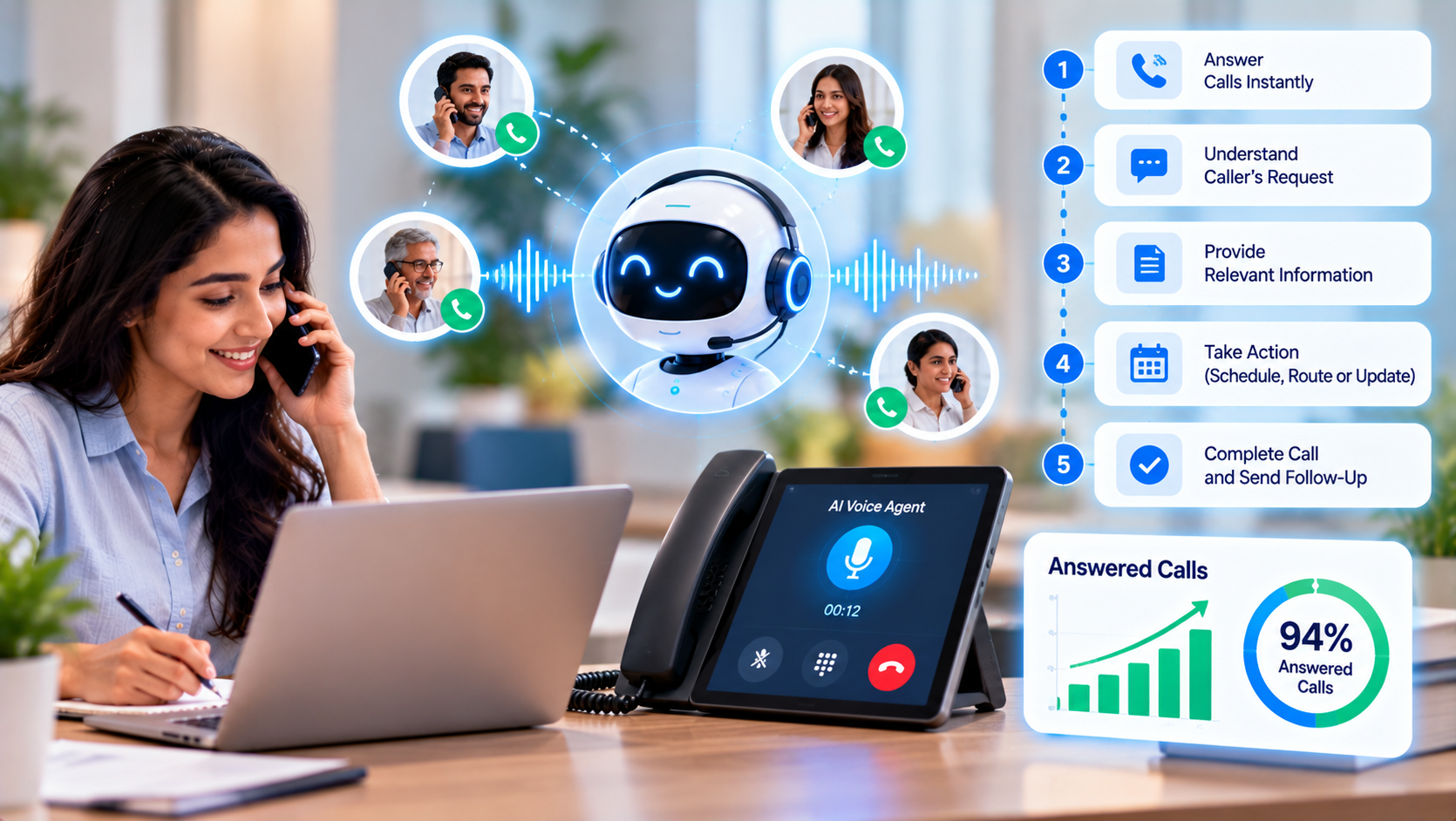
AI voice agent services are offerings that provide a phone assistant powered by artificial intelligence, which answers incoming calls, understands what the caller wants, gives approved information, books appointments or takes messages and passes the call to a person when needed. In the United States, many small businesses miss calls because staff are busy with customers, and callers who reach voicemail often hang up and try a competitor. This guide explains, in a question-and-answer format, how AI voice agent services handle phone calls without sounding robotic, what to check before you buy and how to start in five steps, with a sample answered-calls result and a checklist of rules. It makes no promise of specific results.
Key Findings
- 5 steps build a voice agent callers can live with: define call types and goals, script and test the voice and responses, connect the calendar, CRM and call transfer, handle disclosure, consent and compliance, and review recordings every month.
- In the illustrative model below, the share of inbound calls answered rises from 60% to 95% when all five steps are in place.
- A reliable transfer to a person protects the caller experience in the sample, because some calls always need a human.
- 4 numbers are enough to judge a voice agent: calls answered, calls resolved or booked, transfers and caller feedback.
- All figures in this article are illustrative examples, not guaranteed results.
What Are AI Voice Agent Services?
They are phone assistants that talk in natural language. A caller can say what they need in their own words, and the agent can answer common questions about hours, services and pricing, check the calendar and book a time, take down details and send a summary to your team, or transfer the call when the request is complex or the caller asks for a person. Providers range from software platforms you configure yourself to managed services that build and maintain the agent for you. For the chat version of the same idea, read our guide to AI chatbot development for businesses.
Why Do Some Voice Agents Sound Robotic or Frustrate Callers?
Most frustrate callers because they were launched without enough testing of real calls. Common causes include:
- The agent interrupts callers or leaves long pauses.
- It struggles with accents, noisy lines, names and addresses.
- It cannot recover when it misunderstands, so the caller is trapped in a loop.
- Transfers to a person fail or ring into an unattended line.
- Nobody listens to the recordings, so the same problems repeat. Our article on common AI automation mistakes describes similar issues.
How Can a Business Set Up an AI Voice Agent? 5 Steps
1. Define Call Types and Goals
Know why people call. Review a few weeks of call logs or ask staff to list the reasons: booking, hours, prices, directions, order status, urgent problems. Decide which the agent will handle, which it will only take messages for and which must always go to a person. Set a goal, such as answering every call during business hours and after hours.
2. Script and Test the Voice and Responses
Make the conversation short and natural. Write a clear greeting, a few approved answers and plain-language prompts for names, phone numbers and times. Choose a voice that fits your brand and speaks at a comfortable pace. Test with colleagues, friends and people with different accents, and fix the places where it stumbles. Our guide to AI customer support automation explains how approved answers and guardrails work.
3. Connect Calendar, CRM and Call Transfer
A voice agent is only useful if it can act. Connect it to your calendar so it can book real slots, to your customer record so calls are logged and to your phone system so transfers reach a person quickly. Add a fallback, such as taking a message and promising a callback, if no one is available. A marketing automation service can handle the follow-up after a call, such as a confirmation text or email.
4. Handle Disclosure, Consent and Compliance
Be open about what callers are talking to. Say at the start that the caller is speaking with an automated assistant where rules or good practice require it, tell callers if the call is recorded and follow the consent rules for your state. For outbound calls, be especially careful, because regulators have treated AI-generated voices in calls as artificial voices under the Telephone Consumer Protection Act, so check current guidance and get proper consent.
5. Review Recordings Every Month
Listen to real calls. Each month, listen to a sample, especially transfers and calls that ended badly, and update scripts and answers. Track calls answered, bookings made and transfers. See AI marketing analytics and campaign automation for a simple review routine.
| Area | Common weakness | Stronger approach |
|---|---|---|
| Scope | Agent tries to handle every call | Call types sorted into handle, take message or transfer |
| Conversation | Long scripts and awkward pauses | Short greeting, plain prompts, tested with varied voices |
| Action | Agent can talk but cannot book | Calendar, CRM and phone transfer connected |
| Transparency | Caller unaware they speak with AI | Clear disclosure and recording notice |
| Upkeep | Nobody listens to calls | Monthly review of recordings and transfers |
How Many More Calls Can Be Answered? A Sample Graph
In this illustrative example for a small service business, the share of inbound calls answered rises from 60% to 95%. The bars run from top to bottom in the same order as the table below, and each block (█) equals 5 percentage points.
| Stage | Inbound calls answered | Bar chart |
|---|---|---|
| Staff answer when free, voicemail otherwise | 60% | ████████████ |
| Plus voice agent for common calls | 75% | ███████████████ |
| Plus booking and reliable transfer | 90% | ██████████████████ |
| Plus script tuning and monthly review | 95% | ███████████████████ |
What Should You Measure?
Four measures show whether the voice agent is working.
- Share of inbound calls answered, including after hours.
- Calls resolved or booked without a person.
- Transfers and how quickly a person picks up.
- Caller feedback and complaints, and the total monthly cost.
What Rules Should You Follow?
Calls involve recording, consent and privacy law.
- Follow the laws on recording calls in the states where callers are located, since some require everyone's consent, and tell callers when a call is recorded.
- Disclose that callers are speaking with an automated assistant where laws or good practice require it, and always offer a path to a person.
- For outbound AI-voice calls, get the consent required by the TCPA and state laws, honor do-not-call and opt-out requests and check current rules, because they change.
- Do not collect sensitive information, such as full card numbers or health details, unless the system is approved for it, and follow privacy rules for your industry, including HIPAA where relevant.
- Check the vendor's data storage and whether calls are used to train models, and do not let the agent give legal, medical or financial advice.
Methodology and Limitations
The numbers in this article come from an illustrative model created by Nova Reach Digital to show how each step may affect answered calls. They are not drawn from a published study or a specific client, and no one can guarantee results. Outcomes depend on your call volume, call types, phone system and how well the agent is tuned. This article is general information and not legal, financial or professional advice.
Related Reading
- How fast should you follow up with a new lead?
- How AI keeps your CRM updated without manual data entry
- Where AI can automate everyday business work
Conclusion
AI voice agent services work when callers get a short, natural conversation, real actions such as booking and a dependable way to reach a person. Define the calls, script and test, connect your tools, follow the recording and consent rules and listen to the calls every month. If you want help with an AI voice agent, contact Nova Reach Digital or read more about our automation services.
Get Directions
Frequently Asked Questions
Keep reading
How Does Review Request Automation Help a Small Business Get More Honest Customer Reviews? Reading the Request Timing, the Five Steps and the Sample Reviews Per Month
A question-and-answer guide to review request automation in the United States: when to ask customers, why review efforts fail, 5 steps to set it up, a weak vs stronger table, a sample reviews-per-month chart, honesty rules and FAQs.
How Does AI Lead Scoring Help a Small Sales Team Call the Right People First? Reading the Score Rules, the Five Steps and the Sample Response Time
A question-and-answer guide to AI lead scoring in the United States: how it helps a small sales team call the right people first, why scores go wrong, 5 steps to build one, a weak vs stronger table, a sample response-time chart, rules and FAQs.
How Do You Build Marketing Funnel Automation That Moves Leads From Awareness to Purchase? Reading the Funnel Stages, the Five Steps and the Sample Stage Conversion
A question-and-answer guide to marketing funnel automation in the United States: how to move leads from awareness to purchase, why funnels leak, 5 steps to build one, a weak vs stronger table, a sample stage-conversion chart, rules and FAQs.
Put These Ideas to Work with NovaReach
Automate your marketing, launch AI voice agents, and keep every lead moving, all from one dashboard.