Which Marketing Tasks Should You Automate With AI First? Reading the Workflow Map, the Five Steps and the Sample Follow-Up Gains
A question-and-answer guide to AI marketing automation in the United States: which tasks to automate first, why automations fail, 5 steps to build a reliable one, a weak vs stronger table, a sample follow-up chart, rules and FAQs.
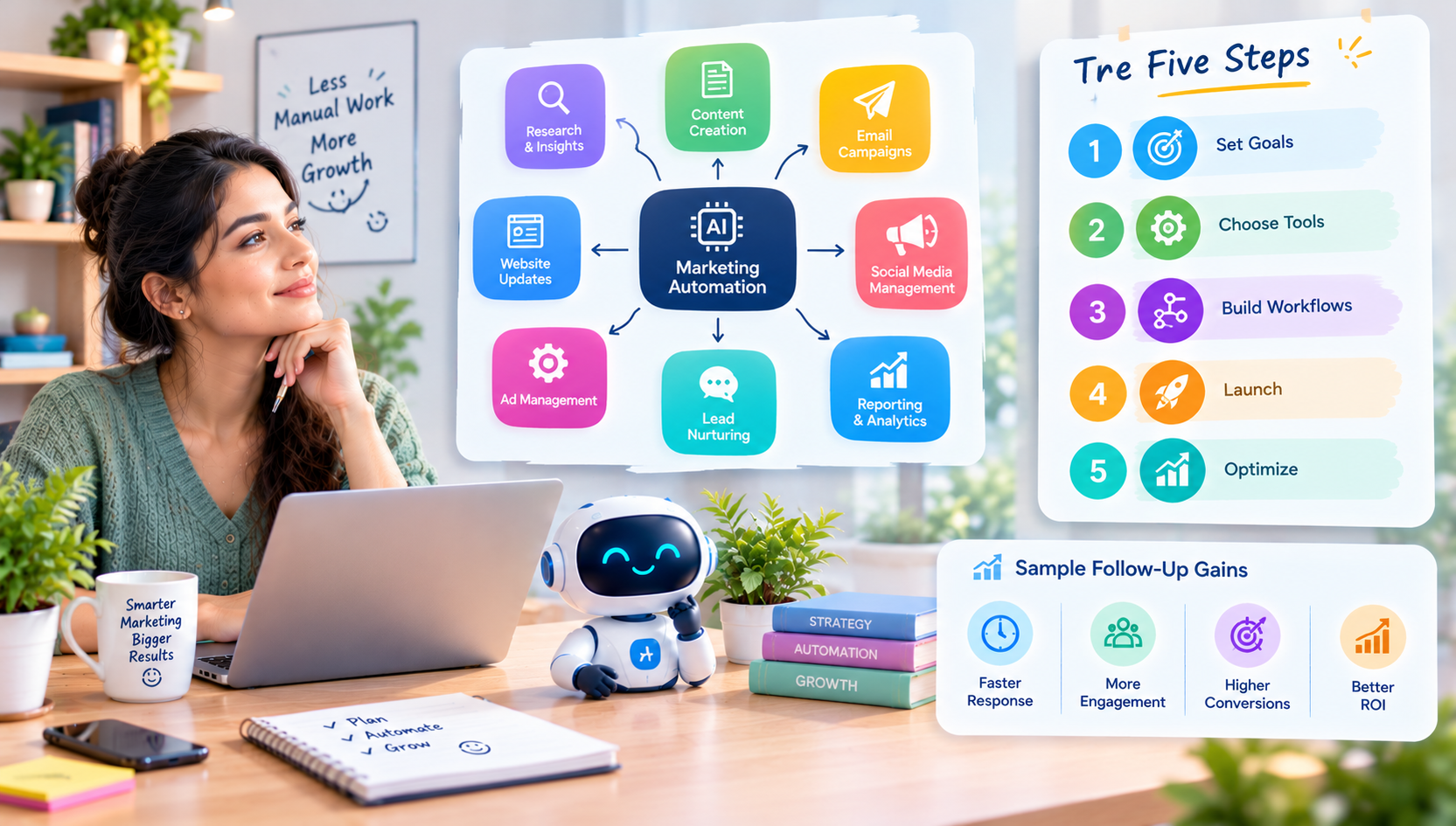
AI marketing automation is the use of software and artificial intelligence to carry out marketing tasks such as replying to new leads, sending follow-up emails and texts, scoring interest and alerting your team, so that no inquiry waits for a person to find the time. In the United States, small and mid-sized businesses often lose leads not because their offer is weak but because the first reply is slow and the follow-up is inconsistent. This guide explains, in a question-and-answer format, which marketing tasks to automate first, why many automations fail and how to build a reliable one in five steps, with a sample result and a checklist of rules. It makes no promise of specific results.
Key Findings
- 5 steps build a reliable automation: map the workflow on paper, automate the first response, add nurture sequences, hand warm leads to a person, and review every month.
- In the illustrative model below, the share of new leads followed up within one hour rises from 20% to 90% when all five steps are in place.
- The instant first reply gives the biggest lift in the sample, because a quick answer keeps a lead interested while it is deciding.
- 4 numbers are enough to track progress: response time, follow-up completion, leads handed to a person and leads that become customers.
- All figures in this article are illustrative examples, not guaranteed results.
What Is AI Marketing Automation?
It is a set of connected rules and AI tools that act when a customer does something. A form fill can trigger a reply, a tag in the customer record, a short email series and a task for a salesperson. AI adds the ability to write a personal first message, sort leads by interest and answer common questions in chat. The goal is not to remove people but to make sure every lead gets a fast, consistent first step. To see how this plays out for local businesses, read our guide on turning leads into customers with AI marketing automation.
Why Do Many Marketing Automations Fail?
Most fail because they are built before the process is understood. Common causes include:
- The workflow was never written down, so the automation copies a messy process.
- Lead data is incomplete or duplicated, so messages go to the wrong people or twice to the same person.
- Messages sound robotic and ignore what the customer actually asked.
- No one takes over when a lead replies with a real question, so the conversation stalls.
- The automation runs for months without a check, and broken steps go unnoticed. Our article on common AI marketing automation mistakes describes these in detail.
How Can a Business Build AI Marketing Automation? 5 Steps
1. Map the Workflow on Paper
Draw the path a lead takes today before you automate anything. Write the trigger (a form, call or message), each step that follows, who does it and how long it takes. Mark the points where leads wait or drop out. This simple map shows what to automate and what to leave to people. The article on AI marketing workflows and business process automation offers a task audit you can reuse.
2. Automate the First Response
Start with the reply that every new lead should receive within minutes. Send a short, personal acknowledgment that confirms what the lead asked, says what happens next and offers a way to book or call. Keep the tone human and the promise realistic. A fast first reply is the easiest automation to build and the easiest to measure.
3. Add Nurture Sequences
Follow up with useful messages, not pressure. Build a short sequence of emails or texts that answer common questions, share proof such as real results or process explanations and invite a next step. Vary the path by what the lead asked about. Our guide to AI marketing analytics and campaign automation shows how to test and improve a sequence over time.
4. Hand Warm Leads to a Person
Automation should end with a human conversation when interest is high. Define what counts as a warm lead, such as a reply, a booking click or repeated visits, and send an instant alert with the lead's history. A marketing automation service can connect these alerts to your customer record and calendar so nothing is missed.
5. Review Every Month
A short monthly review keeps automations healthy. Test each step yourself, check for failed sends, review replies the automation could not handle and update messages that are out of date. Remove steps that do not help, and add one improvement at a time.
| Area | Common weakness | Stronger approach |
|---|---|---|
| Process | Automating an undocumented process | Workflow drawn on paper with triggers, owners and wait points |
| First reply | Hours or days of silence | Personal acknowledgment within minutes |
| Follow-up | One-off message, then nothing | Short sequence that answers real questions |
| Hand-off | Replies sit unseen | Instant alert to a person when a lead is warm |
| Upkeep | Set and forget | Monthly test and review of every step |
How Much Faster Can Follow-Up Become? A Sample Graph
In this illustrative example for a service business, the share of new leads followed up within one hour rises from 20% to 90%. The bars run from top to bottom in the same order as the table below, and each block (█) equals 5 percentage points.
| Stage | Leads followed up within one hour | Bar chart |
|---|---|---|
| Manual follow-up when someone has time | 20% | ████ |
| Plus automated first response | 45% | █████████ |
| Plus nurture sequence and alerts | 70% | ██████████████ |
| Plus hand-off to a person and monthly review | 90% | ██████████████████ |
What Should You Measure?
Four measures show whether the automation works.
- Average time to first reply for each new lead.
- Percentage of leads that complete the follow-up sequence.
- Number of warm leads handed to a person and how fast they are answered.
- Percentage of leads that become customers, and the revenue they bring.
What Rules Should You Follow?
Automated messages must have permission and tell the truth.
- Get consent before sending marketing texts or placing automated or AI-voiced calls, and follow the TCPA and state rules. Check current guidance because these rules change.
- Follow CAN-SPAM for email, including honest sender details and a working unsubscribe link.
- Honor opt-outs quickly across every tool, not only the one that received the request.
- Tell customers when they are chatting with an automated assistant where rules or good practice require it, and give an easy way to reach a person.
- Protect lead data, do not send sensitive information through unsecured channels and do not promise outcomes in automated messages.
Methodology and Limitations
The numbers in this article come from an illustrative model created by Nova Reach Digital to show how each step may affect follow-up speed. They are not drawn from a published study or a specific client, and no one can guarantee results. Outcomes depend on your lead volume, offer, tools and how quickly your team responds to warm leads. This article is general information and not legal, financial or professional advice.
Related Reading
- What an AI marketing agency does for a growing business
- Signs your business is ready for AI marketing automation
- How much AI marketing automation costs
- AI marketing automation and the local market
Conclusion
AI marketing automation works when the process is clear, the first reply is fast, follow-up is useful and a person steps in at the right moment. Map the workflow, automate the first response, add a short nurture sequence, hand warm leads to your team and review every step each month. If you want help building AI marketing automation, contact Nova Reach Digital or read more about our marketing automation services.
Get Directions
Frequently Asked Questions
Keep reading
What Should You Expect From an AI Automation Agency Before You Sign? Reading the Discovery Process, the Five Steps and the Sample Hours Saved
A question-and-answer guide to working with an AI automation agency in the United States: what it builds, why projects stall, 5 steps from discovery to monthly review, a weak vs stronger table, a sample hours-saved chart, rules and FAQs.
Can AI-Powered Digital Marketing Reach Customers at Every Step of the Journey? Reading the Channel Mix, the Five Steps and the Sample Inquiry Growth
A question-and-answer guide to AI-powered digital marketing in the United States: how it works across the customer journey, why campaigns leak customers, 5 steps to build it, a weak vs stronger table, a sample inquiry chart, rules and FAQs.
Which AI Marketing Services Are Worth Paying For First? Reading the Service Menu, the Five Steps and the Sample Time Savings
A question-and-answer guide to AI marketing services in the United States: which services to buy first, why businesses overspend, 5 steps to choose and measure them, a weak vs stronger table, a sample time-savings chart, rules and FAQs.
Put These Ideas to Work with NovaReach
Automate your marketing, launch AI voice agents, and keep every lead moving, all from one dashboard.