Which AI Marketing Solutions Match the Problem You Actually Have? Reading the Problem-Solution Map, the Five Steps and the Sample Booking Gains
A question-and-answer guide to AI marketing solutions in the United States: how to match a solution to your real problem, why businesses buy the wrong one, 5 steps to test it, a weak vs stronger table, a sample booking chart, rules and FAQs.
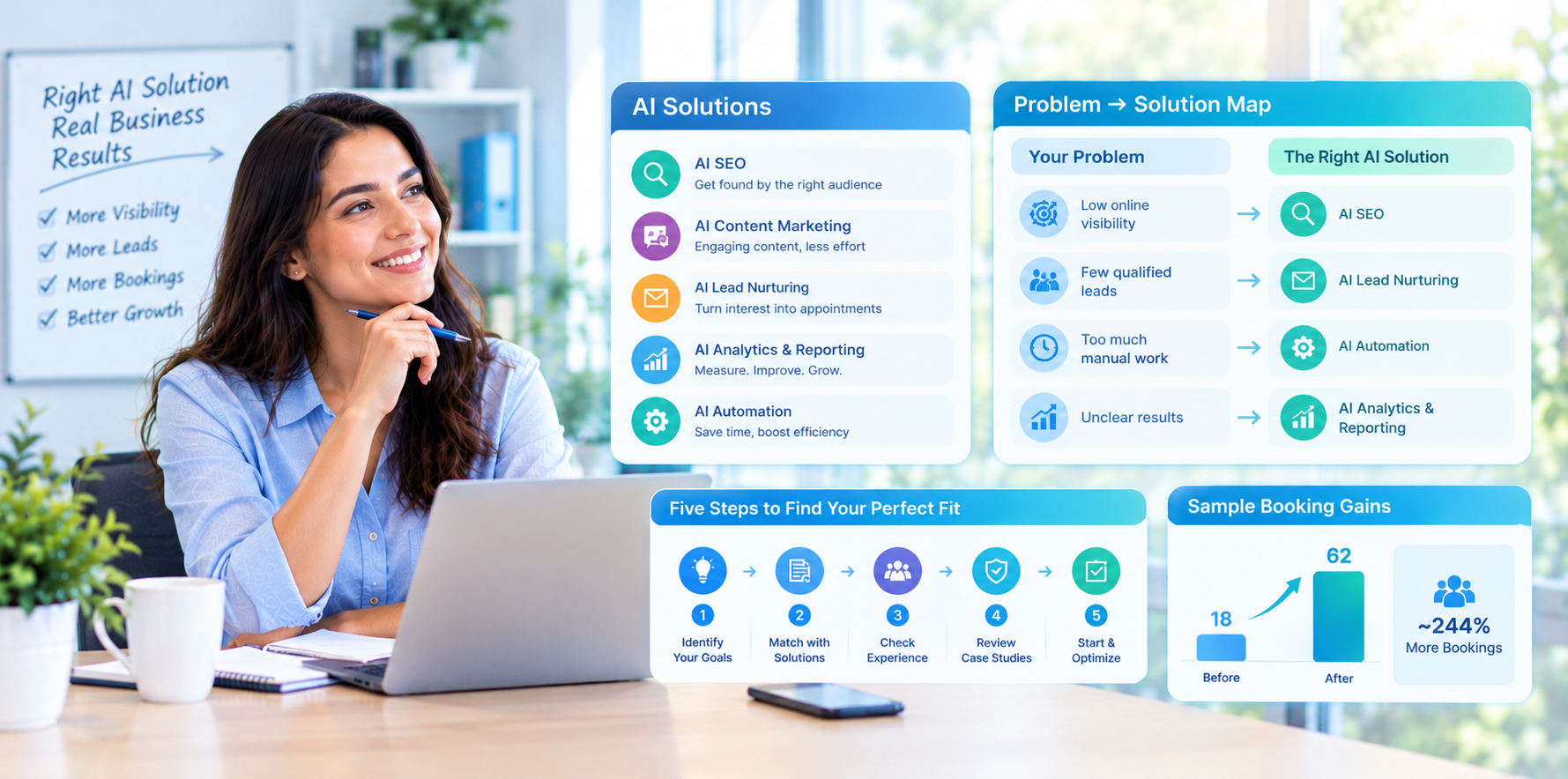
AI marketing solutions are ready-to-use combinations of tools, workflows and support that apply artificial intelligence to a specific marketing problem, such as slow lead response, thin content, low repeat sales or unclear reporting. In the United States, business owners are shown dozens of such solutions, and each claims to be the answer. This guide explains, in a question-and-answer format, how to match AI marketing solutions to the problem you actually have, how to avoid paying for features you will not use and how to test a solution in five steps, with a sample result and a checklist of rules. It makes no promise of specific results.
Key Findings
- 5 steps lead to a good match: name the problem in numbers, match the problem to a solution type, check fit with your stack and team, run a time-boxed trial, and scale what works while reviewing monthly.
- In the illustrative model below, the share of inquiries that become bookings rises from 10% to 28% when all five steps are in place.
- Starting with the problem, not the product gives the biggest lift in the sample, because it prevents buying a solution that does not touch the real bottleneck.
- 4 numbers are enough to judge a solution: the problem metric you chose, time saved, cost per result and customer feedback.
- All figures in this article are illustrative examples, not guaranteed results.

What Are AI Marketing Solutions?
They are packaged answers to a defined marketing problem. One solution might answer new inquiries instantly and book appointments. Another might draft and schedule content, while another scores leads and alerts sales. Some are software, some are managed services and some combine both. They differ from single tools because they include setup, workflows and often ongoing support. To understand the building blocks, see our guide to AI marketing services worth paying for first.
Why Do Businesses Buy the Wrong AI Marketing Solution?
Most buy the wrong one because the demo was impressive but the problem was never defined. Common causes include:
- The business buys a broad platform when it only needs one fix, such as faster replies.
- The solution does not connect to the customer record or calendar already in use.
- The team is not trained, so features go unused.
- Success is not defined, so no one can say whether the solution helped.
- The vendor promises results that depend on factors it does not control. Our guide on signs your business is ready for AI marketing automation can help you check readiness first.
How Can You Match AI Marketing Solutions to Your Problem? 5 Steps
1. Name the Problem in Numbers
Describe the problem with a figure you can measure. Examples are "only 10% of inquiries become bookings," "replies take a day" or "we spend 15 hours a week on posts." A number gives you a starting point and a way to judge any solution later. If you cannot measure it yet, spend two weeks collecting a rough baseline.
2. Match the Problem to a Solution Type
Each problem points to a different kind of solution. Slow replies call for instant response and booking. Thin content calls for AI-assisted drafting with human editing. Weak repeat sales call for follow-up and reminder sequences. Unclear results call for reporting dashboards. Our guide to AI marketing strategy for small and local businesses shows how to map problems to the customer journey.
3. Check Fit With Your Stack and Team
A good solution works with what you already use. Ask which systems it connects to, who sets it up, how long it takes and who will operate it day to day. Check security, data ownership and what happens to your data if you leave. A smaller solution that your team actually uses beats a larger one that sits idle.
4. Run a Time-Boxed Trial
Test on real work for 30 to 60 days. Agree the target metric, the start and end dates and who reviews the results. Keep a person checking messages and decisions made by the AI. At the end, compare the numbers with your baseline and decide to continue, change or stop. A marketing automation service can be a practical trial for lead response problems.
5. Scale What Works and Review Monthly
Add the next solution only after the first proves itself. Each month, check the problem metric, time saved and cost per result, and listen to customer feedback. Use the approach in AI marketing analytics and campaign automation to keep reviews short.
| Area | Common weakness | Stronger approach |
|---|---|---|
| Problem | "We need AI" with no target | One problem described with a measurable baseline |
| Choice | Broad platform bought after a demo | Solution type matched to the specific problem |
| Fit | Does not connect to existing tools | Integrations, security and data ownership checked first |
| Test | Annual contract at once | 30 to 60 day trial with start and end dates |
| Growth | Many solutions added together | Next solution added only after the first is proven |
How Much Can a Matched Solution Improve Bookings? A Sample Graph
In this illustrative example for an appointment-based business, the share of inquiries that become bookings rises from 10% to 28%. The bars run from top to bottom in the same order as the table below, and each block (█) equals 2 percentage points.
| Stage | Inquiries that become bookings | Bar chart |
|---|---|---|
| Slow replies and manual scheduling | 10% | █████ |
| Plus instant reply and online booking | 16% | ████████ |
| Plus follow-up and reminder sequence | 22% | ███████████ |
| Plus trial review and monthly improvement | 28% | ██████████████ |
What Should You Measure?
Four measures show whether the solution solves the problem.
- The problem metric you named in step one, compared with the baseline.
- Staff hours saved per week.
- Cost per result, such as cost per booking, including software and support.
- Customer feedback, such as complaints or praise about the automated experience.
What Rules Should You Follow?
Any solution that talks to customers must be lawful and honest.
- Get consent before marketing texts or automated calls, and follow the TCPA and state laws that apply.
- Follow CAN-SPAM for email, with a clear unsubscribe.
- Tell customers when they are chatting or speaking with an automated assistant where rules or good practice require it, and offer an easy way to reach a person.
- Check vendor security and data practices, and keep ownership of your customer data.
- Do not accept guarantees of results, and review AI-generated content for accuracy before it is published.
Methodology and Limitations
The numbers in this article come from an illustrative model created by Nova Reach Digital to show how each step may affect inquiry-to-booking rates. They are not drawn from a published study or a specific client, and no one can guarantee results. Outcomes depend on your market, offer, team and how well the solution is set up. This article is general information and not legal, financial or professional advice.
Related Reading
- Which marketing tasks to automate with AI first
- AI-powered digital marketing across the customer journey
- How much AI marketing automation costs
- AI marketing for startups on a lean budget
Conclusion
The right AI marketing solution is the one that fixes a measured problem, fits your tools and team and proves itself in a short trial. Name the problem, match the solution, check fit, test for 30 to 60 days and review the numbers every month. If you want help choosing AI marketing solutions, contact Nova Reach Digital or read more about our marketing services.
Get Directions
Frequently Asked Questions
Keep reading
What Does a Practical AI Marketing Strategy Look Like for the Next 90 Days? Reading the Roadmap, the Five Steps and the Sample Adoption Growth
A question-and-answer guide to building an AI marketing strategy in the United States: what a practical 90-day plan includes, why plans fail, 5 steps to build one, a weak vs stronger table, a sample adoption chart, rules and FAQs.
How Should a Business Choose AI Marketing Tools Without Wasting Budget? Reading the Tool Categories, the Five Steps and the Sample Cost Savings
A question-and-answer guide to choosing AI marketing tools for businesses in the United States: which categories matter, why money is wasted, 5 steps to choose and test tools, a weak vs stronger table, a sample cost chart, rules and FAQs.
Do AI-Powered Marketing Solutions Deliver Value Beyond the Hype? Reading the Proof Points, the Five Steps and the Sample Repeat-Customer Growth
A question-and-answer guide to AI-powered marketing solutions in the United States: how to test vendor claims, why some fail to deliver, 5 steps to get real value, a weak vs stronger table, a sample repeat-customer chart, rules and FAQs.
Put These Ideas to Work with NovaReach
Automate your marketing, launch AI voice agents, and keep every lead moving, all from one dashboard.